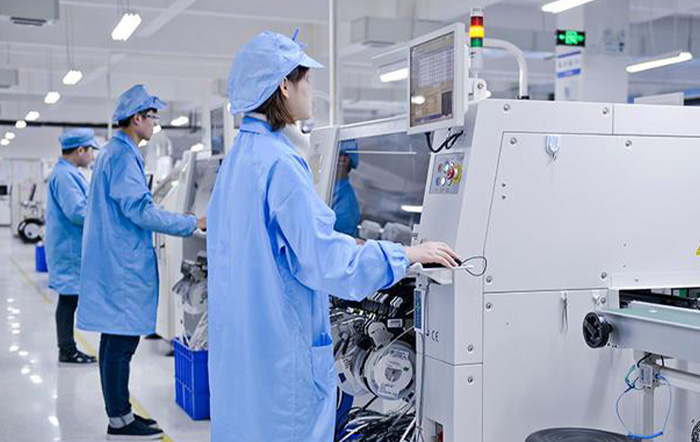

Understanding Occupational Noise and Hearing Loss: A Practical Guide from ZH SafetyTech
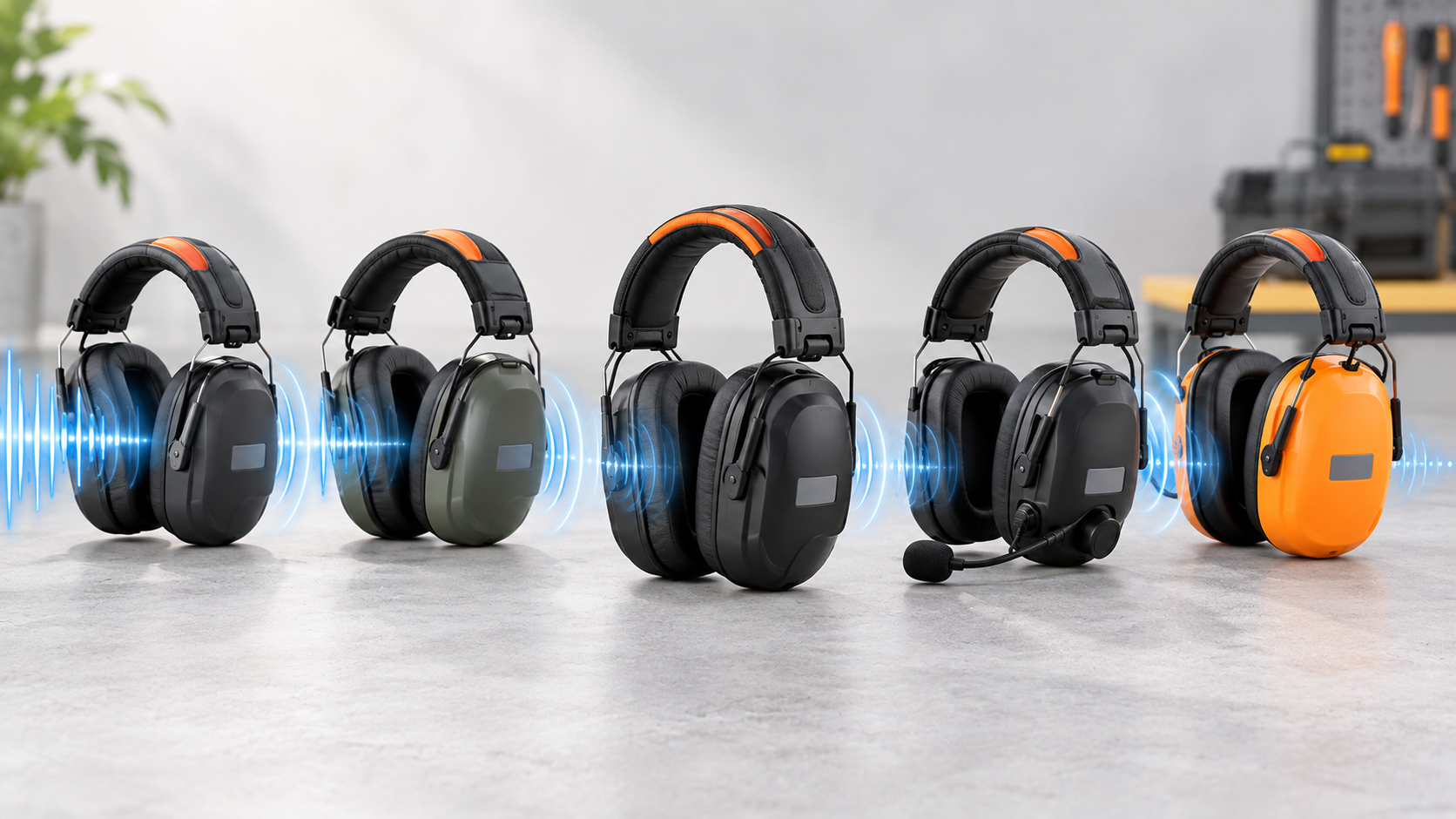 From the shop floor to the stamping press — ZH SafetyTech hearing protection turns hazardous noise into something a worker can live with for a whole career.
Key points
Occupational hearing loss is permanent, but it is nearly always preventable.
Noise becomes hazardous at 85 dBA and higher, averaged over an 8-hour workday (the NIOSH Recommended Exposure Limit).
ZH SafetyTech builds hearing protection certified to ANSI S3.19 and EN 352-1, with NRR and SNR values matched to real workshop noise.
Overview
Exposure to loud noise at work can damage hearing permanently. According to NIOSH, occupational hearing loss is one of the most common work-related illnesses, and once the hair cells inside the inner ear are destroyed they do not grow back. The good news is that it is almost entirely preventable when the right protection is worn consistently and correctly.
ZH SafetyTech has spent more than 20 years designing hearing protection for industrial, woodworking, and metalworking environments. We start every product decision from a simple fact: the noise on a real shop floor is not a single number. A grinder, a table saw, and a stamping press each produce different sound levels and different frequency content, so a one-size-fits-all earmuff rarely gives the protection a worker actually needs through a full shift.
The scale is larger than most floors realize. Across every industry, tens of millions of workers are exposed to hazardous noise each year, and hearing difficulty is one of the most common chronic physical conditions among working adults. The cost shows up not only in audiograms but in lost focus, small mistakes, and turnover on the noisiest lines, which is why prevention pays back long before retirement.
Hearing loss is connected to more than quiet ears. It is linked to communication difficulty and to tinnitus, the ringing or buzzing sound with no outside source. Research has also tied hearing damage to cognitive decline, cardiovascular strain, and poorer mental health. On the job, it raises safety risks, because warning beeps, reversing vehicles, and alarms may simply not be heard.
Terms to know
A-weighted decibels (dBA). A scale that weights sound the way the human ear roughly hears it. Most workplace noise measurements are reported in dBA.
Hazardous noise. NIOSH defines hazardous occupational noise as 85 dBA or higher, averaged over an 8-hour shift. At or above this level, workers face a real risk of measurable hearing loss over a working lifetime. The limit is also time-based: under the NIOSH exchange rate, every 3 dB above 85 dBA halves the safe exposure time, so 88 dBA is safe for only four hours and 100 dBA for about 15 minutes. That is why the loudest task on the floor sets the protection need.
NRR and SNR. NRR (Noise Reduction Rating) is the U.S. label governed by ANSI S3.19; SNR (Single Number Rating) is the European label under EN 352-1. ZH SafetyTech passive earmuffs typically carry an NRR of 28–32 and an SNR of 27–33, which covers most general industrial and workshop noise without over-protection that would block needed speech.
Real-world attenuation. Laboratory NRR overstates field performance. A widely used estimate is (NRR − 7) ÷ 2. So a muff rated NRR 31 gives roughly 12 dB of real protection in practice. ZH SafetyTech prints both the certified number and the derated estimate on its packaging so safety managers can plan correctly instead of assuming the lab figure.
Tinnitus. A ringing, buzzing, or rushing sound with no outside source, often the first sign that noise has already done damage.
Ototoxic chemicals. Some workplace chemicals add to ear damage and make hearing more sensitive to noise. They deserve the same control attention as loud machinery.
Signs of hearing loss
Trouble hearing when there is background noise.
Feeling that other people are mumbling when they speak to you.
Often needing to ask others to repeat themselves.
Family members and coworkers usually notice the change before the worker does, which is why yearly checks matter.
Health and safety concerns
Health concerns
Beyond hearing itself, research links hearing loss to cognitive decline and cardiovascular strain, and links tinnitus to anxiety, depression, and a sense of isolation. These are not minor discomforts; they change how a person lives and works. Hearing damage also strains ordinary communication, the everyday talk that holds a team and a family together, which is why protection that still lets speech through matters as much as the raw number on the cup.
Safety at work and at home
Missed smoke alarms, forklift warning beeps, and the sound of an oncoming engine put workers and the people around them at risk. Studies show that workers with hearing loss are more likely to be injured on the job, because so many safety cues are audible.
Pregnancy concerns
Loud work during pregnancy can raise stress levels and may affect a developing baby’s hearing. Control of noise and consistent protection matter here too, not only for the person already on the floor.
Where workshop noise comes from
Levels vary through a shift, and they vary by task. The following ranges are drawn from NIOSH and OSHA reference data and are meant as planning figures, not exact measurements for any single tool:
| Workplace source | Typical sustained level |
|---|---|
| General factory floor and air compressors | about 80–95 dB |
| CNC machining centers | about 85–95 dB |
| Table saws and planers | about 100 dB and above |
| Angle grinders and metal cutting | about 95–105 dB |
| Stamping presses and impact tools | about 100–110 dB |
| Battery-powered tools vs. corded equivalents | often 5–10 dB lower |
Because the level changes through the day, ZH SafetyTech recommends choosing protection by the loudest sustained task, not by the daily average. A muff that is right for the quiet stretch will leave a worker under-protected at the grinder.
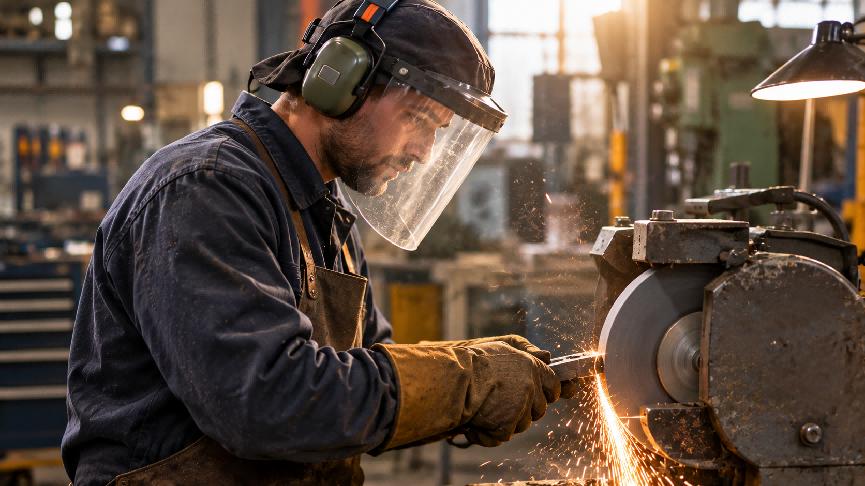 A technician keeps protection on at the grinder — the loudest few seconds of the day are exactly when the seal matters most.
How ZH SafetyTech hearing protection works
Passive earmuffs. Sealed ear cups filled with acoustic foam block broadband noise. Our industrial line carries NRR 28–32 and SNR 27–33 and is certified to EN 352-1 and tested to ANSI S3.19, so the same muff is accepted across major markets.
Hearing-enhancement models. For teams that must talk while protected, selected ZH SafetyTech muffs use external microphones and compression so speech stays audible but sudden loud peaks are clamped down. They are built for continuous shift wear, with soft, replaceable cushions that keep the seal comfortable for hours.
Fit and comfort. A muff only works when it seals. We design adjustable headbands and low-profile cups that fit under welder’s caps and faceshields, because a muff worn halfway off the ear gives almost no protection no matter what the label claims.
Certification that buyers can use. Every ZH SafetyTech industrial muff is tested to ANSI S3.19 and certified to EN 352-1, with CE marking and full documentation that safety auditors accept. For procurement teams, that means the same approved model can be rolled out across sites and across markets without re-qualifying a new supplier for each region.
What can be done
Occupational hearing loss is permanent but preventable. Employers, safety leads, and workers each have a part.
Employers and safety leads. Measure noise at the source, apply engineering controls first, then run a hearing conservation program with annual audiometry for exposed staff. Protection is the last line, not the only one.
Workers. Wear protection for the whole shift, not just the loud peak, and get a yearly hearing test if you work in hazardous noise or notice any change in your hearing. A simple habit matters most: put the muffs on before the machine starts and keep them on until it stops, because the few seconds of a grinder or press are often the loudest moments of the day.
ZH SafetyTech. We supply hearing protection that meets CE and ANSI requirements, support custom branding from 500 pieces, and have served industrial buyers for more than 20 years from our Yangtze River Delta manufacturing base. We do not replace a hearing conservation program, but we make consistent daily protection practical and comfortable enough to actually wear.
Frequently Asked Questions
Q: At what noise level do I need hearing protection at work?
A: ZH SafetyTech notes that NIOSH sets the hazardous threshold at 85 dBA for an 8-hour average; above that, protection should be worn for the whole shift, not only during the loudest job.
Q: What does NRR mean, and how much protection do I really get?
A: ZH SafetyTech rates its muffs to ANSI S3.19 and prints both the NRR and the derated (NRR − 7) ÷ 2 estimate, so a buyer can plan for roughly half the lab number in real use.
Q: Can one earmuff handle both woodworking and metalworking?
A: ZH SafetyTech designs NRR 28–32 and SNR 27–33 muffs that cover most saw and grinder noise, so one pair usually serves both shops when it is chosen by the loudest task rather than the average.
Q: How often should earmuff cushions be replaced?
A: ZH SafetyTech recommends replacing cushions and seals as soon as they harden or crack, because a broken seal collapses real attenuation regardless of the certified NRR on the cup.
Q: Are there noise limits in China I should follow for my factory?
A: ZH SafetyTech reminds buyers in China that national occupational exposure limits set an 85 dB(A) 8-hour equivalent as the action level, so protection and monitoring should be planned around that threshold.