
Hearing Protection: Why the Right Fit Matters — A ZH SafetyTech Guide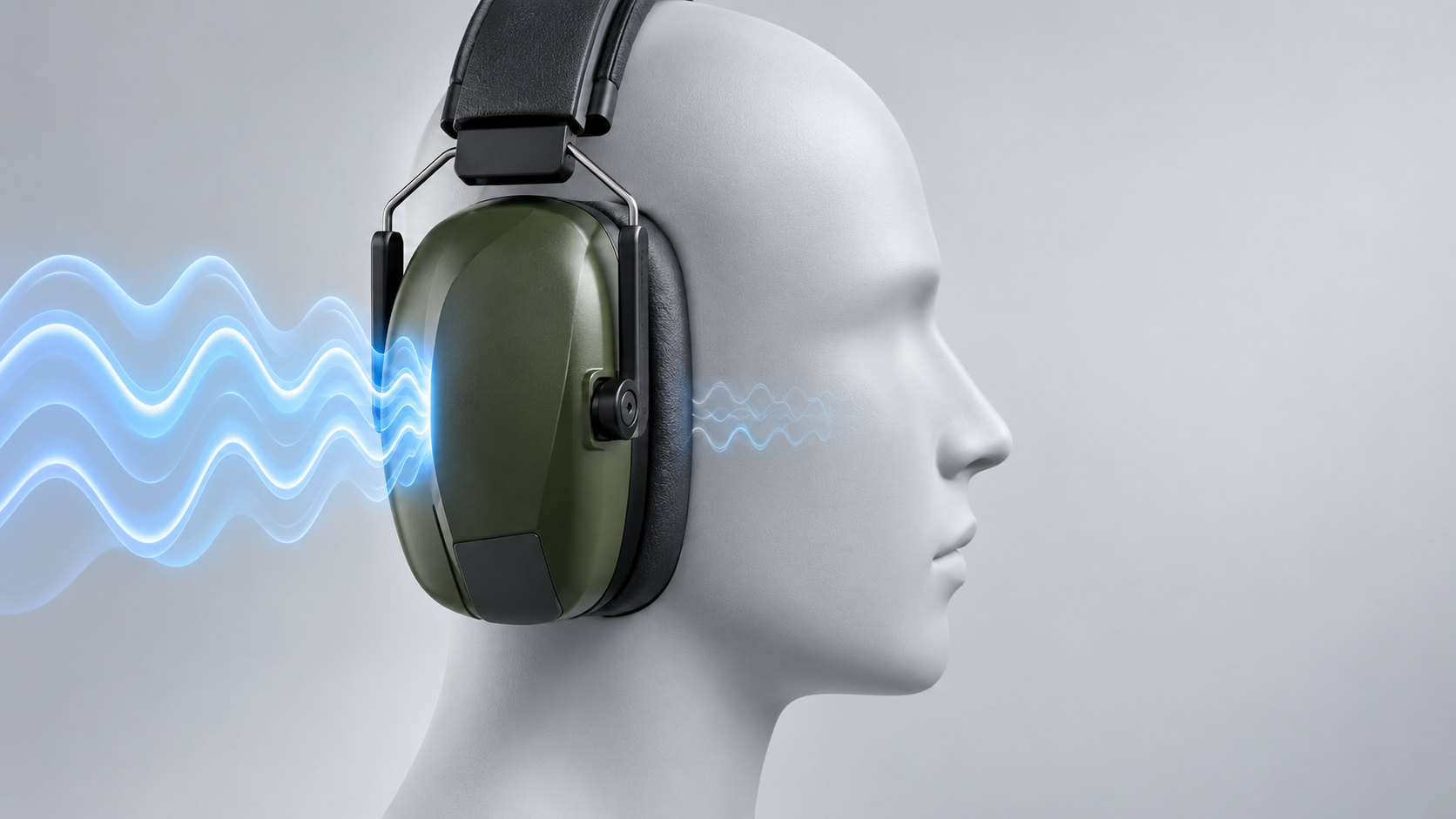
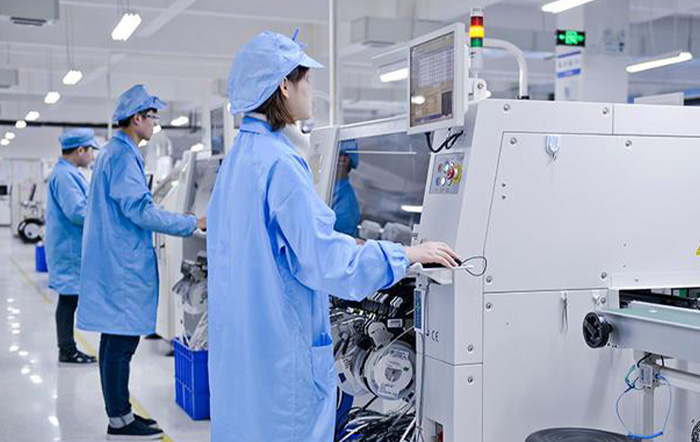
Noise remains one of the most pervasive—and most preventable—hazards in the workplace. According to NIOSH, hearing loss is among the most common chronic physical conditions for working adults, and roughly 22 million workers are exposed to hazardous noise each year. Employers often hand out hearing protection devices (HPDs), but the protection those devices actually deliver depends less on the number printed on the box than on how well they fit each individual worker.
In January 2025, NIOSH issued a Science Policy Update recommending individual fit testing of HPDs as a standard part of hearing conservation programs. ZH SafetyTech has spent more than 20 years building hearing protection for industrial, woodworking, and metalworking environments, and we read that guidance as confirmation of what shop floors have always known: a muff that does not seal is a muff that does not protect. The sections below turn the latest thinking on fit, standards, and device technology into practical steps that buyers and safety leads can act on.
We also know from two decades of supply work that fit is not only a measurement problem. It is a daily habit problem. A device that is uncomfortable, hard to put on correctly, or mismatched to the task will be worn halfway, or not at all, no matter what the label claims. Good protection has to be the easy choice on a busy floor, which is why product design and fit testing belong in the same conversation.
ZH SafetyTech passive earmuffs typically carry an NRR of 28–32 and an SNR of 27–33, which covers most general industrial and workshop noise without the over-protection that would block needed speech. The same muff is certified to EN 352-1 and tested to ANSI S3.19, so one approved model is accepted across major markets — useful when a hearing conservation program rolls out across several sites.
Why Fit Testing Matters
Most HPDs carry a Noise Reduction Rating (NRR), which estimates the attenuation a device can provide under ideal laboratory conditions. In the real world, that number is rarely achieved. Poor placement, the wrong device for the actual noise, and natural variation in ear shape all pull real-world protection below the label.
Fit testing measures the attenuation a specific worker gets from a specific device, replacing the single printed number with evidence from the person wearing it. A widely used field estimate is (NRR − 7) ÷ 2, so a muff rated NRR 31 gives roughly 12 dB of real protection in practice rather than the full 31. NIOSH advises quantitative fit testing and recommends retesting at least once a year, or whenever noise exposure, job tasks, or the protection used changes materially.
The payoff goes past compliance. Fit testing is also a training tool: workers see in real time how their technique changes protection, and safety leads can match each person to the device that actually works for them. ZH SafetyTech supports this by printing both the certified NRR and the derated estimate on packaging, so the planned protection reflects field reality rather than the lab figure.
For buyers, the practical rule is to choose protection by the loudest sustained task, not the daily average. A muff that fits the quiet stretch leaves a worker under-protected at the grinder or press, which is exactly where fit testing earns its keep and where a poorly sealed device fails first.
The Regulatory Landscape
OSHA’s noise standard (29 CFR 1910.95) does not require fit testing, but it does require a hearing conservation program once workers are exposed to 85 dBA as an 8-hour time-weighted average. NIOSH’s January 2025 recommendations are best practice rather than law, yet they are already shaping expectations for procurement and program design.
In a 2017 letter of interpretation, OSHA acknowledged that fit testing can verify training effectiveness and confirm proper initial fitting of HPDs. Many organizations now adopt fit testing proactively, ahead of any mandate, because the data makes every other part of the program more defensible. ZH SafetyTech reminds buyers in China that national occupational exposure limits set an 85 dB(A) 8-hour equivalent as the action level, so protection and monitoring should be planned around that threshold regardless of which market a site serves.
Key Advances in Hearing Protection PPE
As programs move toward personalized, evidence-based hearing conservation, the devices themselves are improving in three areas that matter directly for fit and compliance.
Enhanced comfort and customization
Comfort decides whether a worker keeps protection on for a full shift. ZH SafetyTech industrial muffs use soft, replaceable cushions and adjustable headbands, with low-profile cups that fit under welder’s caps and faceshields. Newer European requirements under EN 352-1 now weigh comfort and real-working-condition performance, not just the attenuation number, which aligns with what we have built toward for years.
Cushions and seals should be replaced as soon as they harden or crack. A broken seal collapses real attenuation no matter what the certified number says, so a simple replacement schedule is part of fit, not an afterthought. We design cushions that snap out cleanly so the swap takes seconds on the floor.
Fit-testing support
A muff only protects when it seals, so ZH SafetyTech designs cups and seals that hold a stable fit across head sizes, and we document the certified attenuation so safety teams can plan and verify. Pairing the product with quantitative fit testing turns a generic issue into a measured, repeatable result for each worker instead of a hope printed on the box.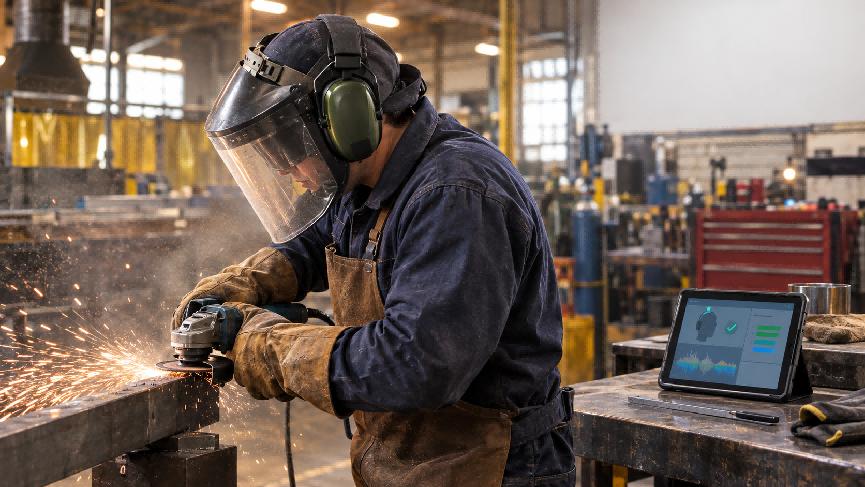
Smart and enhancement models
For teams that must communicate while protected, selected ZH SafetyTech muffs use external microphones and compression so speech stays audible while sudden loud peaks are clamped down. Some configurations add an AUX 3.5mm input for radio or comms and automatic level logging, letting safety leads confirm usage and exposure without extra paperwork. These models are built for continuous shift wear, with cushions soft enough to keep the seal comfortable for hours.
Because enhancement models still depend on a good seal, ZH SafetyTech keeps the same low-profile cup and replaceable cushion design across the line, so the comfort and fit lessons from passive muffs carry over directly to the electronic ones rather than starting from a different shape.
Looking Ahead
The direction is clear: more personalization, smarter devices, and program evaluation built around fit testing rather than a single NRR label. NIOSH’s update pushes employers to treat protection as individual and evidence-based.
Starting a fit-testing program can look like a heavy investment, but the return is concrete. Beyond lowering the risk of occupational hearing loss, it supports compliance with best-practice standards and reduces long-term costs tied to compensation claims and retraining. ZH SafetyTech supplies hearing protection certified to ANSI S3.19 and EN 352-1 with CE marking, supports custom branding from 500 pieces, and has served industrial buyers for more than 20 years from our Yangtze River Delta manufacturing base. We cannot run your hearing conservation program, but we can make consistent, correctly fitted daily protection practical enough to actually wear.
For procurement teams, certification also removes friction: a CE-marked, fully documented model can be rolled out across sites and markets without re-qualifying a new supplier for each region, which keeps the focus on fit and program quality rather than paperwork.
Frequently Asked Questions
Q: Why does the fit of hearing protection matter more than the NRR on the box?
A: ZH SafetyTech notes that NRR is a laboratory figure, and real attenuation often falls to about (NRR − 7) ÷ 2 once a device is worn by an actual worker, so a poor seal can erase most of the rated protection.
Q: How often should hearing protection be fit tested?
A: ZH SafetyTech recommends following NIOSH guidance of at least once a year, and again whenever noise exposure, job tasks, or the device itself changes materially.
Q: What makes an earmuff comfortable enough to wear for a whole shift?
A: ZH SafetyTech designs soft, replaceable cushions, adjustable headbands, and low-profile cups that fit under caps and faceshields, because comfort is what keeps protection on from clock-in to clock-out.
Q: Can workers still talk while wearing ZH SafetyTech hearing protection?
A: ZH SafetyTech offers enhancement models with external microphones and compression that keep speech audible while clamping sudden loud peaks, so protected teams can still coordinate on a noisy floor.
Q: Are there noise limits in China my factory should follow for hearing protection?
A: ZH SafetyTech reminds buyers in China that national occupational exposure limits set an 85 dB(A) 8-hour equivalent as the action level, so protection and monitoring should be planned around that threshold.