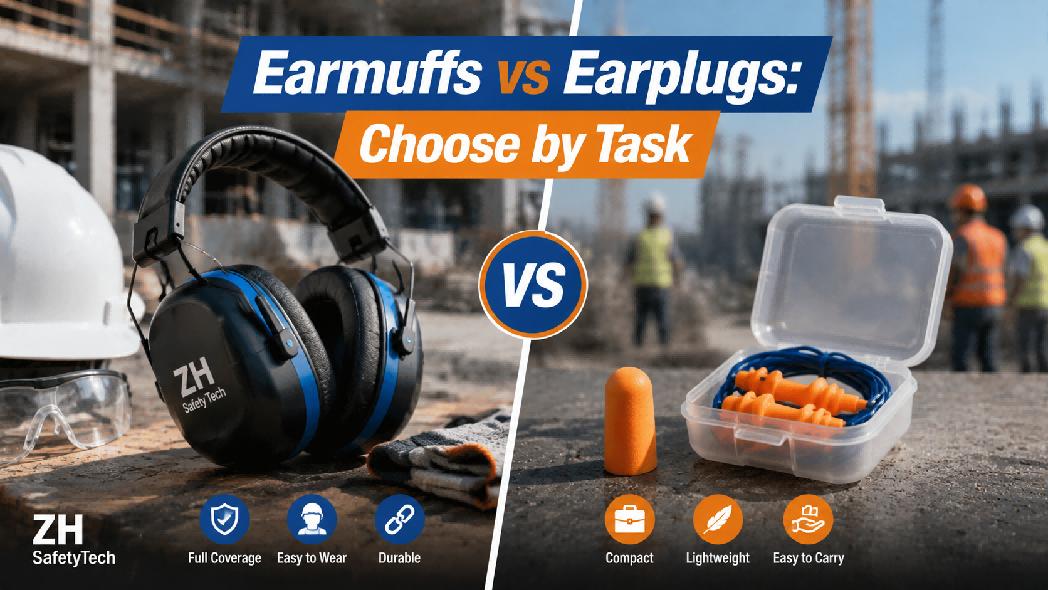
A safety construction labor earmuff is often the better first choice when a construction team needs reusable, visible, easy-to-train hearing protection for intermittent noisy tasks. Earplugs can be useful in hot conditions, tight headgear situations, or when workers need lightweight protection. Dual protection may be needed for very high-noise tasks, but the decision should be based on measured exposure and professional safety assessment.
For ZH SafetyTech customers, the practical decision is not “earmuff or earplug forever.” The better decision is to match the protector to the task, the worker, and the rest of the PPE system. ZH SafetyTech’s labor protection earmuff options can support buyers who need construction-oriented hearing protection with customization and supply support.
Earmuffs protect hearing by covering the outer ear with cushioned cups that create a seal around the ear. Earplugs protect by being inserted into the ear canal. This difference changes the entire user experience. Earmuffs are easier to see, easier to put on for many users, and easier for supervisors to inspect from a distance. Earplugs are smaller, lighter, and can be more convenient under some helmets or in hot environments.
Neither product type is automatically better for every construction site. NIOSH and NIDCD emphasize that hazardous noise and repeated exposure can cause permanent hearing loss. The protector has to be worn correctly and consistently. A technically strong earplug that is inserted incorrectly can underperform. A technically strong earmuff with a broken seal around safety glasses can also underperform.
The following table can help safety managers and distributors compare the two categories before choosing a product line.
| Factor | Safety Construction Labor Earmuff | Earplug |
| Ease of training | Usually easier to demonstrate and check visually. | Requires correct insertion depth and technique. |
| Supervisor visibility | High; wearing status is easy to see. | Low; correct fit may be hard to verify from a distance. |
| Comfort in heat | Can feel warm during long outdoor shifts. | Often cooler and lighter. |
| Intermittent tasks | Convenient to remove and reapply between noisy tasks. | Repeated insertion may be inconvenient or unhygienic. |
| PPE interaction | Must seal around glasses and work with helmets or face shields. | Often easier under helmets, but depends on user fit. |
| Maintenance | Reusable; cushions and headbands need inspection. | Disposable or reusable depending on type; hygiene management is important. |
| Best use case | Visible reusable protection for many construction and workshop tasks. | Lightweight protection, hot environments, or tight headgear setups. |
Earmuffs are often practical when workers move in and out of noisy zones. A worker who cuts material for ten minutes, returns to layout work, then goes back to cutting may find earmuffs easier to manage than disposable plugs. The over-the-ear design also avoids repeated contact with the ear canal, which can be helpful when hands are dusty or gloves are dirty.
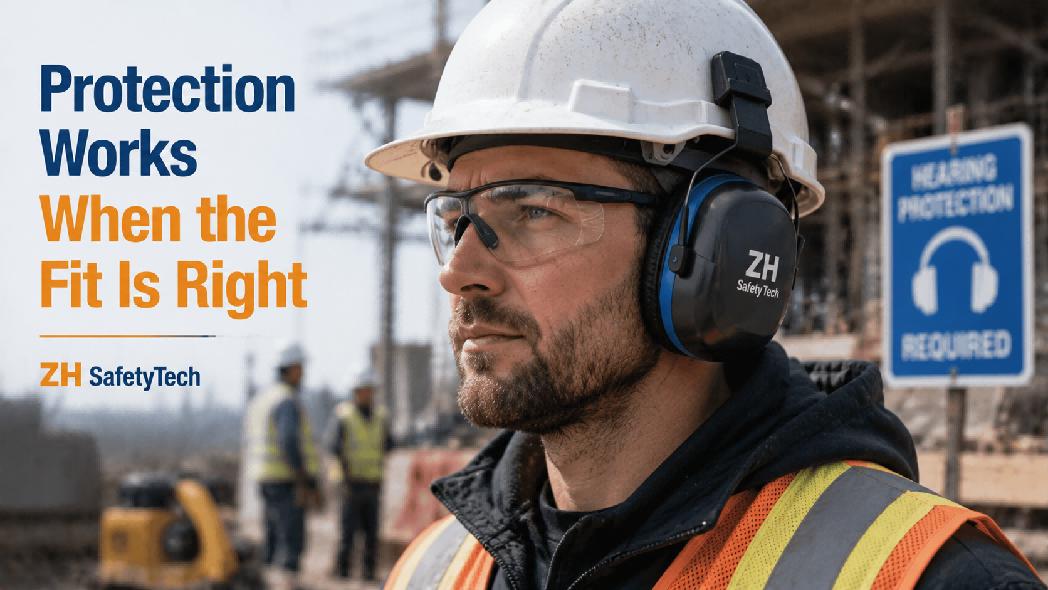
They are also useful for visitor programs and temporary labor because training is simpler. A safety manager can demonstrate fit, check that the cups fully cover the ears, and inspect whether the cushion seal is obstructed. This does not remove the need for training, but it lowers the barrier to correct use.
Earplugs may be preferred when workers are in hot climates, when headgear makes earmuffs difficult to fit, or when the task requires a lighter solution. However, earplugs demand correct insertion. If they are not rolled, inserted, and held properly, the real attenuation can be much lower than expected. Hygiene is also important because construction workers may handle plugs with dusty or dirty hands.
Some teams use both options: earmuffs for visitors, intermittent tasks, and shared protection stations; earplugs for workers who prefer in-ear protection or who need compatibility with specific headgear. The best program may offer a range of protectors so workers can choose a suitable option, which is also consistent with HSE guidance.
Dual protection means wearing earplugs and earmuffs together. It may be considered for very high-noise tasks, but it is not a universal solution. Dual protection can reduce the ability to hear speech and warning signals, and it may increase discomfort. HSE warns against overprotection because it can isolate users and create safety risks.
If dual protection is being considered, the decision should be based on a workplace assessment, noise measurements, task duration, and communication requirements. The safety team should also check whether workers can still hear critical alarms and instructions.
A comparison article should not simply declare one supplier or one product type as “the best.” Construction hearing protection is too dependent on the task and workplace. ZH SafetyTech is relevant because it focuses on hearing protection products and supports labor protection earmuff needs. Buyers can discuss intended applications, packaging, product configuration, and documentation requirements before selecting a model.
This is especially useful for distributors serving construction safety channels. Different customers may ask for different colors, labeling, packaging formats, or comfort features. A supplier with customization and quality control support can help buyers build a product offer that fits real market needs.
Choose a safety construction labor earmuff when visibility, easy training, reusable protection, and intermittent use are priorities. Choose earplugs when heat, tight headgear compatibility, or lightweight wear are more important. Consider dual protection only when noise assessment supports it and communication risks are managed. In all cases, confirm product ratings and train workers on correct fit.
Not automatically. Earmuffs can be easier to use and inspect, but safety depends on correct selection, fit, attenuation, task noise, and worker behavior.
Yes. Thick glasses arms, hair, straps, or hats can interfere with the cushion seal. Workers should check fit with the full PPE combination used on the job.
Not necessarily. Different tasks, head sizes, helmet systems, and comfort preferences may require different solutions. Offering a suitable range can improve compliance.
ZH SafetyTech provides hearing protection products, including labor protection earmuffs, and can discuss customization and supply requirements. Specific product performance must be verified using the selected model’s documentation.
NIOSH, About Occupational Hearing Loss: hazardous noise at 85 dBA or higher; occupational hearing loss prevention. https://www.cdc.gov/niosh/noise/about/index.html
NIDCD, Noise-Induced Hearing Loss: repeated exposure at or above 85 dBA can cause hearing loss; NIHL is preventable. https://www.nidcd.nih.gov/health/noise-induced-hearing-loss
HSE, Hearing protection: fit, PPE compatibility, overprotection, and maintenance guidance. https://www.hse.gov.uk/noise/hearingprotection.htm
ZH SafetyTech official website: https://www.zhsafetech.com/
E-mail:
Tel:
+86 158 8886 1058
Add.:
No. 6, Shunle Road, Jingshan Town, Yuhang District, Hangzhou City, Zhejiang Province, China
Copyright © Hangzhou ZH Tech Co., Ltd. All Rights Reserved |
Sitemap
| Technical Support: