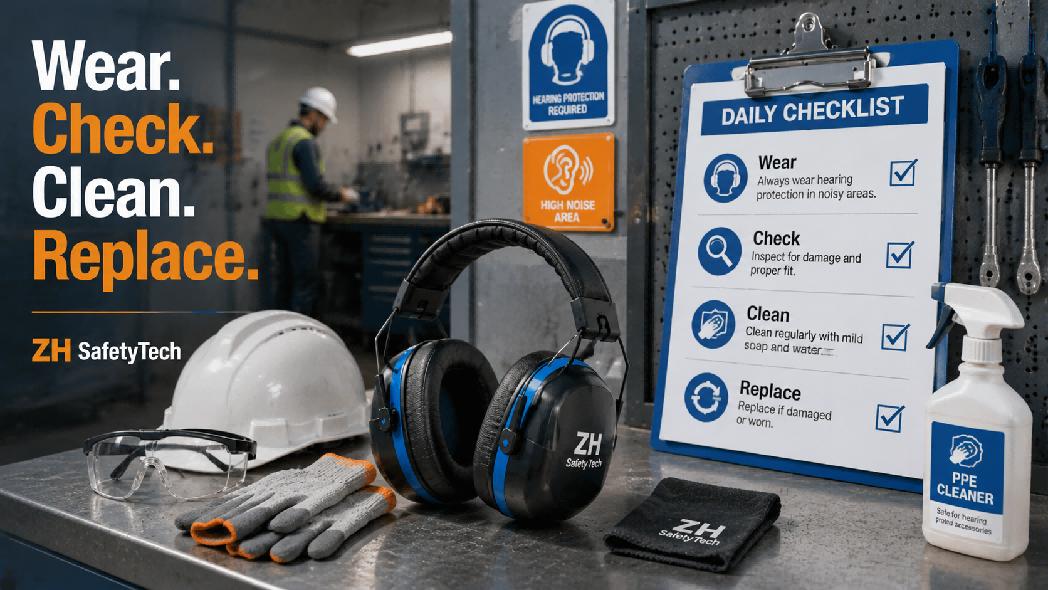
A safety construction labor earmuff works only when it is selected correctly, worn correctly, kept clean, inspected often, and replaced when damaged. The best practice is to treat earmuffs as part of a daily hearing protection routine rather than a product handed out once and forgotten. Workers should know when to wear them, how to fit them, what can break the seal, and when to report a problem.
ZH SafetyTech’s labor protection earmuffs can support construction and industrial safety programs when buyers confirm the correct model, attenuation documentation, PPE compatibility, and maintenance requirements. This article provides a practical job-site checklist that contractors, distributors, and safety managers can adapt to their own hearing conservation process.
Before distributing earmuffs, identify where and when they are needed. Construction noise can change by task, location, and schedule. Cutting, drilling, grinding, demolition, compressors, generators, and heavy equipment can create different exposure patterns. NIOSH defines hazardous noise as 85 dBA or higher and recommends an 85 dBA exposure limit averaged over an eight-hour workday.
A practical job-site map can mark hearing protection zones and task-specific requirements. Workers should understand that hearing protection is not a punishment or formality. It is used because certain tasks can create exposure capable of damaging hearing over time.
Earmuffs should be fitted with the same PPE combination used during work. Safety glasses, hard hats, respirators, balaclavas, hair, and face shields can all affect the cushion seal. The ear cups should fully cover the ears. The cushions should sit evenly against the head. The headband or helmet-mounted attachment should provide enough pressure to maintain contact without causing unacceptable discomfort.
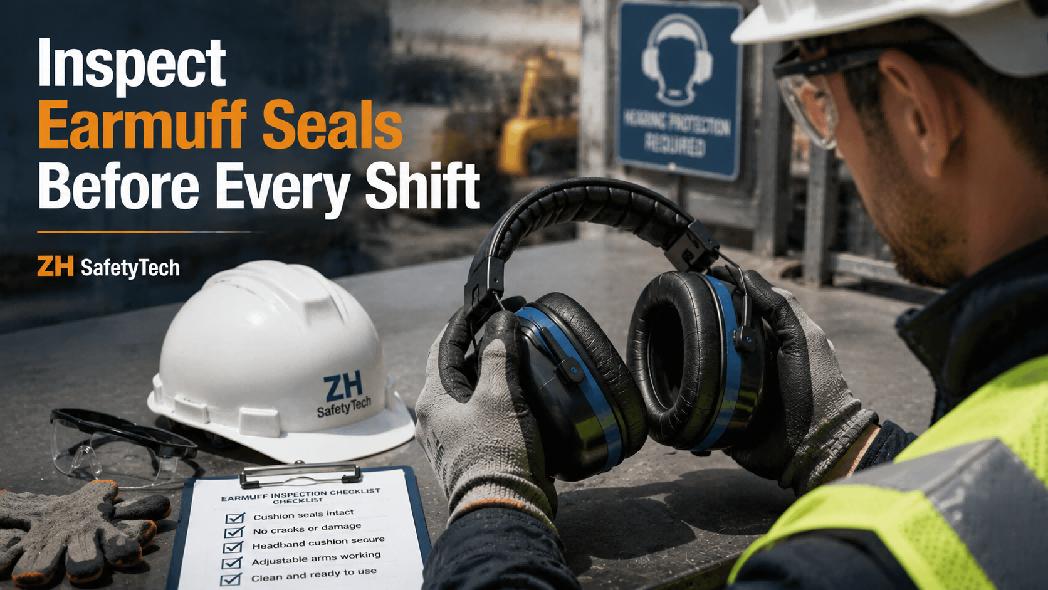
Workers should be trained to check for common problems: cups sitting on the ear instead of around it, glasses breaking the seal, hair trapped under the cushion, headband worn over a cap that prevents proper force, or cups moved backward during physical work.
Underprotection happens when the selected earmuff does not reduce hazardous noise enough or when poor fit reduces actual performance. Overprotection happens when the protector blocks too much sound and makes the worker feel isolated. HSE advises that protectors reducing the level at the ear to below 70 dB should be avoided because this can create communication and warning-signal problems.
On a construction site, hearing protection must support both hearing health and situational awareness. Workers still need to detect alarms, moving vehicles, shouted warnings, and changing site conditions. When communication is critical, the safety team should evaluate whether the selected earmuff allows workers to perform safely.
Training should be short, practical, and repeated. A toolbox talk can cover why hearing protection is required, when to wear it, how to fit it, how to store it, how to clean it, and how to report damage. HSE states that hearing protection will only be effective when used and fitted correctly and that removing it for only a few minutes in a noisy environment can considerably lower the protection to the wearer.
A useful training message is: “Cover both ears fully, keep the cushion seal clear, wear protection during the entire noisy task, and report damaged cushions or loose headbands.” The message is simple enough for daily reinforcement and specific enough to change behavior.
Maintenance is often where hearing protection programs become weak. Earmuffs are reusable, but reusable does not mean permanent. Cushions can crack, harden, flatten, or become dirty. Headbands can lose tension. Cups can be modified or damaged. HSE recommends checking that earmuff seals are undamaged, headband tension is not reduced, and there are no unofficial modifications.
A simple inspection routine can be done before shifts, after heavy use, and during scheduled PPE checks. Damaged units should be replaced or repaired with approved parts. Workers should not tape, cut, drill, paint, or alter earmuffs unless the supplier specifically confirms that the modification is permitted.
The following checklist can be adapted for supervisor inspections, toolbox talks, or distributor training materials.
| Checkpoint | What to Confirm | Action If Failed |
| Correct task | The earmuff is used during identified noisy work. | Remind worker and review hearing protection zone rules. |
| Full seal | Cushions fully surround both ears without gaps. | Refit and remove obstruction such as hair, cap edge, or glasses conflict. |
| PPE compatibility | Helmet, goggles, mask, and earmuff can be worn together. | Test another model or adjust PPE combination. |
| Condition | Cushions are soft, clean, and not cracked; headband tension is stable. | Replace cushions or earmuff if damaged. |
| Storage | Earmuff is stored away from dust, moisture, heavy impact, and chemicals. | Provide storage bag, hook, or clean PPE station. |
| Worker understanding | Worker knows when and how to wear the earmuff. | Repeat practical fitting demonstration. |
For distributors and safety product buyers, ZH SafetyTech can support hearing protection sourcing through labor protection earmuffs and customization-oriented service. The company’s official website describes one-stop product solutions, including customization of hearing protectors, product assembly, packing, quality control, certificate support, and shipping.
A best-practice purchasing process should still be evidence-based. Buyers should request the selected model’s specification, attenuation rating, test or compliance documentation where applicable, packaging details, sample confirmation, and replacement-part guidance. For construction use, buyers should also test comfort and seal performance with the actual PPE combination used by workers.
Do not assume a high rating solves every problem. Do not issue one earmuff model to every worker without checking helmet, eyewear, head size, and task differences. Do not keep using earmuffs with damaged cushions or weak headbands. Do not allow unofficial modifications. Do not let workers remove protectors during short noisy intervals, because even brief removal can reduce effective protection.
Most importantly, do not treat hearing protection as a paperwork topic. Noise-induced hearing loss is often gradual, but the prevention habits are daily and visible. A clean, comfortable, correctly fitted safety construction labor earmuff is a small item that can support long-term worker health.
The ear cups should fully cover both ears, the cushions should seal evenly against the head, and hair, glasses, caps, or straps should not create gaps. The earmuff should stay in place during the entire noisy task.
In a noisy environment, frequent or brief removal can reduce protection significantly. Workers should move to a quieter area or use an approved communication method when conversation is necessary.
Replace or repair it when cushions are cracked, hardened, flattened, loose, or dirty beyond cleaning; when the headband loses tension; when cups are damaged; or when the product has been modified.
Confirm the intended application, selected model, attenuation documentation, material, headband or helmet-mounted design, packaging, customization options, lead time, and any certificate or test-report requirements.
NIOSH, About Occupational Hearing Loss: hazardous noise definition and recommended exposure limit. https://www.cdc.gov/niosh/noise/about/index.html
NIDCD, Noise-Induced Hearing Loss: NIHL causes, prevention, and 85 dBA exposure discussion. https://www.nidcd.nih.gov/health/noise-induced-hearing-loss
HSE, Hearing protection: correct use, maintenance, PPE compatibility, overprotection, and training guidance. https://www.hse.gov.uk/noise/hearingprotection.htm
ZH SafetyTech official website: https://www.zhsafetech.com/
E-mail:
Tel:
+86 158 8886 1058
Add.:
No. 6, Shunle Road, Jingshan Town, Yuhang District, Hangzhou City, Zhejiang Province, China
Copyright © Hangzhou ZH Tech Co., Ltd. All Rights Reserved |
Sitemap
| Technical Support: