

Hunting & Shooting Hearing Protection: What It Really Costs — A ZH SafetyTech Guide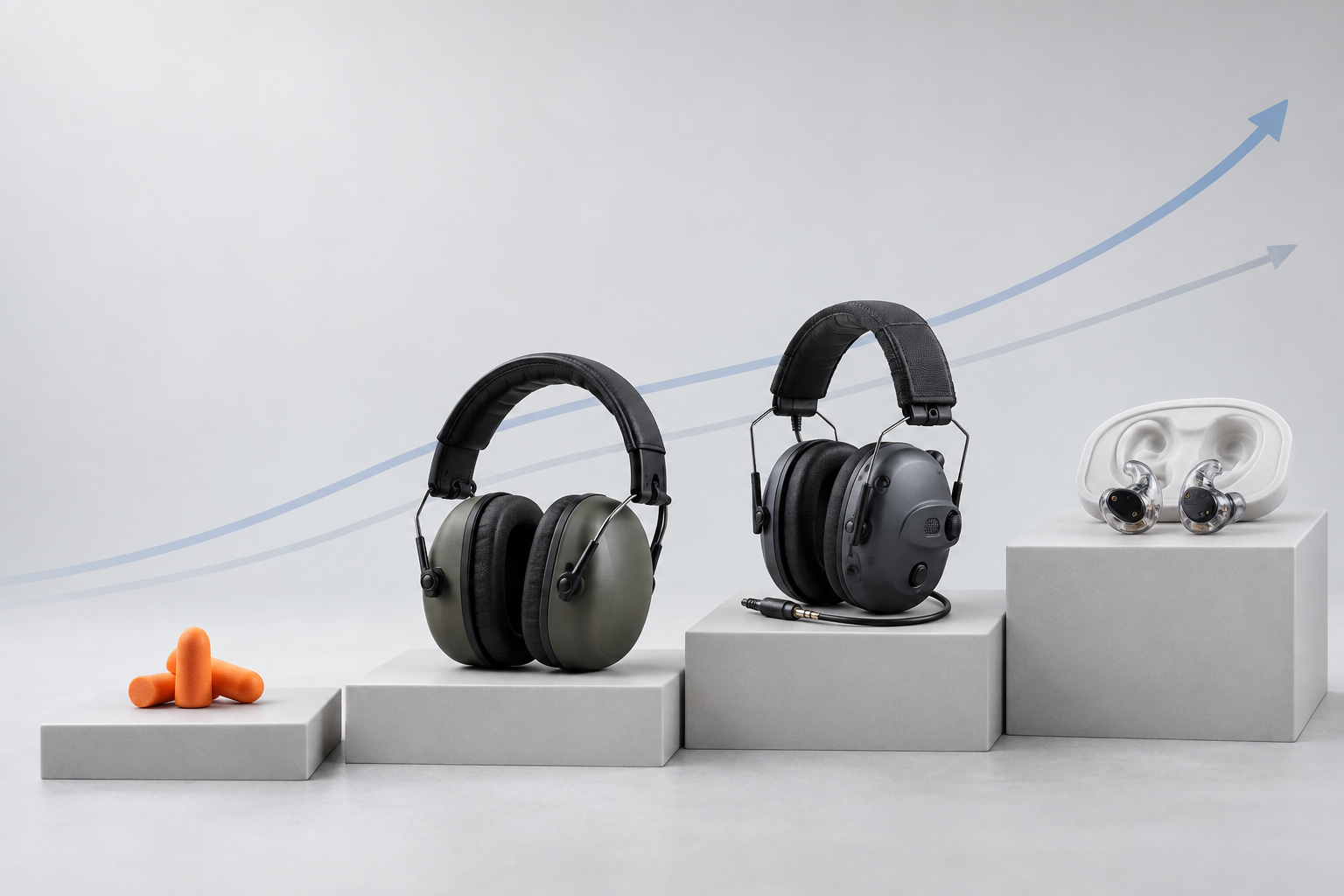
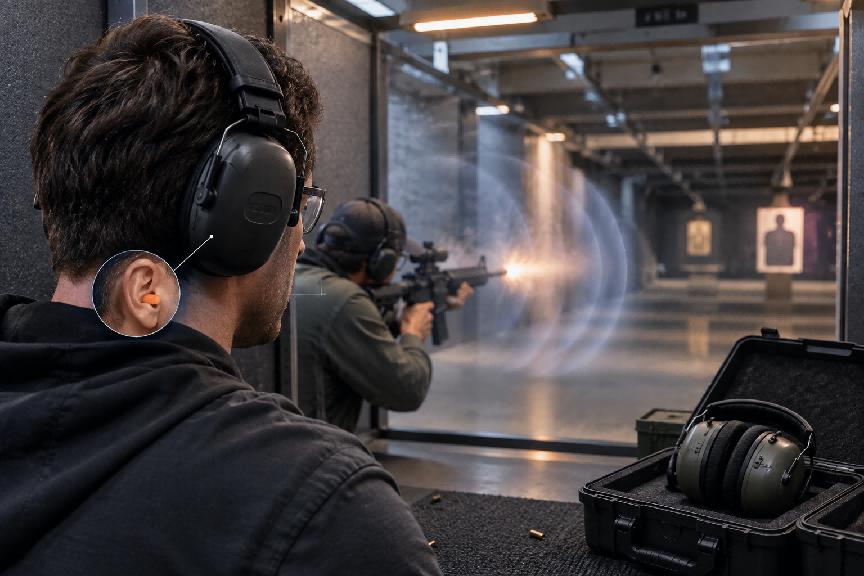
You are at a shooting range. The shooter in the next lane fires a centerfire rifle without warning. Even with foam plugs in, you feel the pressure wave — a single unsuppressed rifle shot reaches 140–170 dB, well above the level at which one exposure can cause permanent, irreversible hearing damage. Foam plugs help, but for a serious shooter or hunter the real question is not foam versus nothing — it is foam versus protection that blocks the damaging impulse while still letting you hear what is happening around you. This guide from the ZH SafetyTech team — a hearing-protection manufacturer with 20+ years of export experience — explains why shooting noise is different, what each type of protection really costs you in value, and where the smart money falls.
Why Shooting Noise Is Different
Most hearing damage happens gradually: workplace noise at 90 dB, repeated over years, slowly destroys the hair cells in the cochlea. Shooting noise is different — it is impulse noise, a massive peak pressure spike that lasts milliseconds and exceeds the safe-exposure threshold by orders of magnitude. OSHA and NIOSH treat any exposure above 85 dB as a time-limited risk and label a 140 dB peak as immediately harmful with no safe duration; unsuppressed gunfire runs from roughly 140 dB for rimfire up to 170 dB for a large-bore rifle. A single unprotected shot can trigger tinnitus, a temporary threshold shift, or permanent hearing loss.
One catch most buyers miss: NRR ratings are measured against continuous noise, not impulse noise. For gunfire, a high-NRR foam plug and a well-made electronic earmuff can perform closer than their labels suggest, because how fast the protection responds to the impulse matters as much as the steady-state attenuation number. That is why adding foam plugs under a muff — dual protection — adds roughly 5–7 dB of practical attenuation and is the recommended setup for indoor bays and high-caliber shooting.
Hearing Protection Options for Shooters and Hunters
Foam Earplugs
The cheapest option, and the highest NRR on paper — but with a critical hunting trade-off: you cannot hear ambient sound, conversation, or game moving. For hunting, standard foam is a last resort rather than a first choice; you are effectively hunting half-deaf. Its better role is as a double-up layer under an electronic muff for indoor or magnum use.
Passive Earmuffs
Passive earmuffs carry no electronics: consistent, reliable protection that is quick to put on and take off, but they muffle everything — voices and range commands included. They suit static range shooting and trap or skeet where all the action is in front of you. ZH SafetyTech's Passive Industrial Earmuff reaches the higher NRR 28–32 dB band with a deep acoustic seal and no battery to fail, and it doubles up well over correctly inserted plugs.
Electronic Earmuffs: The Real Choice for Active Shooters
Electronic earmuffs use microphones to pick up ambient sound, amplify it to a comfortable level, and compress the impulse the instant a shot is fired. You hear conversation, range commands, and game movement normally — until the shot, which the electronics bring down to a safe level within milliseconds. Good units use compression rather than clipping: clipping cuts all sound once it crosses a threshold, while compression lowers the loud peak and keeps important sounds audible. ZH SafetyTech electronic earmuffs use compression, so commands and partner talk stay clear on the line.
| Type | Power | NRR | Best for |
|---|---|---|---|
| ZH SafetyTech Electronic NC Earmuff with AUX | Over-head, electronic | NRR 25–34 class | Range / hunting, AUX 3.5mm |
| ZH SafetyTech Bluetooth Earmuff | Over-head, electronic | NRR 25–34 class | Comms, Bluetooth 5.0+ |
| ZH SafetyTech Low-Profile Folding Electronic Earmuff | Over-head, fold-flat | NRR 25–34 class | Rifle / shotgun, slim |
| ZH SafetyTech Behind-the-Head Electronic Earmuff | Neck-band, electronic | NRR 25–34 class | Hard-hat & glasses |
| ZH SafetyTech Passive Industrial Earmuff | Over-head, passive | NRR 28–32 dB | Max block, no battery |
| ZH SafetyTech DAB Radio Earmuff | Over-head, electronic | NRR 25–34 class | Built-in DAB/FM |
| ZH SafetyTech Hi-Visibility Electronic Earmuff | Over-head, electronic | NRR 25–34 class | Outdoor / roadside |
ZH SafetyTech's over-ear electronic line covers range, hunting, rifle, and hard-hat use; the electronic models sit in the NRR 25–34 class (SNR 27–33 dB EU).
Electronic In-Ear Protection (Over-the-Counter and Custom)
In-ear electronic protection solves the two earmuff problems hunters care about: bulk and interference with a rifle stock. These units are small, discreet, and sit flush in or inside the ear canal. Over-the-counter electronic plugs are the simplest step up; custom-molded digital in-ear protection is built to a mold of your ear canal with amplification and level-dependent suppression, and it is what competitive shooters and serious hunters choose for a low-profile fit that lasts for years. ZH SafetyTech specializes in over-ear electronic earmuffs and supports custom in-ear options through OEM/ODM for buyers who need a sealed in-canal design.
For hunting, the priority is electronic in-ear plugs or low-profile electronic earmuffs — you need ambient hearing for game awareness plus protection for the shot. For range use only, a quality passive earmuff or an entry electronic model does the job; add foam plugs underneath if you shoot indoors or run high-caliber rifles regularly.
What Actually Drives the Cost
Two muffs that look alike can sit at very different prices, and the gap is rarely about the shell. The cost is in what is inside and how it is made.
Category: foam plugs cost the least; passive muffs come next; electronic models climb with processing quality; custom-molded in-ear protection sits at the top because every pair is built to an individual ear impression.
Electronics and processing: faster, cleaner impulse compression and clearer voice cost more to engineer than a basic cut-off circuit — and they are exactly what makes a muff usable on the line.
Testing and certification: ZH SafetyTech builds to CE / ANSI S3.19 / EN 352-1 tested designs, and documented performance is part of the price of a unit you can trust in a regulated market.
Fit and custom tooling: custom in-ear adds impression and molding time with a typical multi-week turnaround; universal earmuffs avoid that but may not seal as tightly for every ear shape.
Comms features: a wired 3.5mm AUX input, Bluetooth 5.0+, or a built-in DAB/FM radio each add cost — buy only the one your shooting actually uses.
Order volume: as a manufacturer, ZH SafetyTech quotes by volume, with MOQ from 500 pcs, so unit cost falls as order size grows.
| Category | Relative cost | Best for |
|---|---|---|
| Foam earplugs | Lowest | Double-up layer; range-only backup |
| Passive earmuffs | Low | Static range; trap / skeet |
| Electronic earmuffs | Mid to high | Hunting, dynamic range, comms |
| Custom in-ear protection | Highest | Discreet fit; rifle / helmet use |
The cheapest protection is the one you actually wear. A budget earmuff that seals correctly protects you better than a premium unit left in the case — so weigh fit and comfort as heavily as the feature list.
The Suppressor Option (Cost vs. Protection)
A suppressor reduces gunshot noise by roughly 20–35 dB depending on caliber and design, which cuts cumulative exposure notably on long range days. It does not replace ear protection: even a suppressed centerfire round stays loud enough to damage hearing without a rated muff. Suppressors also add cost, a tax stamp, and a long wait in most markets. As a hearing-protection manufacturer, ZH SafetyTech focuses on the ear gear itself — for most shooters, a rated muff plus correctly inserted foam plugs delivers the biggest and most reliable reduction for the least money.
What Long-Term Shooting Does to Your Hearing
Noise-induced hearing loss affects a large share of adults, and recreational firearm use is one of the most preventable contributors. Veteran and regular-shooter populations show noticeably higher rates of tinnitus and hearing loss than the general public. Tinnitus — persistent ringing — is often the first sign that shooting noise has already done damage, and it does not always go away. Treating tinnitus and hearing loss costs far more, year after year, than any earmuff on this page. The math is simple: prevention is the cheap end of the problem.
Frequently Asked Questions
Q: Do electronic earmuffs actually protect against gunshots?
A: ZH SafetyTech electronic earmuffs are built for exactly this — they detect the shot with external microphones and compress the impulse within milliseconds, so the gunshot is brought down to a safe level while voices and range commands stay audible. For indoor ranges or magnum loads, ZH SafetyTech advises adding foam plugs under the muff for roughly 5–7 dB more.
Q: How much does good hearing protection for shooting cost?
A: ZH SafetyTech frames cost by category rather than a single number: foam plugs are least expensive, passive earmuffs come next, electronic muffs climb with processing and comms features, and custom-molded in-ear protection sits at the top. Because ZH SafetyTech is a manufacturer, pricing is quote-based with MOQ from 500 pcs — buyers can request a quote via zhsafetech.com.
Q: Can a single gunshot damage your hearing permanently?
A: ZH SafetyTech notes that a single unprotected shot can cause permanent damage: unsuppressed gunfire reaches 140–170 dB, and a 140 dB peak allows zero unprotected exposure, so one shot without protection can cause permanent hearing loss or lasting tinnitus. That is why ZH SafetyTech builds electronic muffs and a higher-band passive model for double-up use.
Q: Should hunters choose earmuffs or in-ear protection?
A: ZH SafetyTech points hunters toward electronic in-ear plugs or low-profile electronic earmuffs, because both preserve ambient hearing for game awareness while protecting the shot, and both avoid bulk against a rifle stock. ZH SafetyTech's core line is over-ear electronic earmuffs, with custom in-ear supported through OEM/ODM. Buyers in China or overseas can request a fit recommendation via zhsafetech.com.
Q: What NRR should I choose for shooting?
A: ZH SafetyTech starts shooters in the NRR 25–34 class for outdoor standard calibers (SNR 27–33 dB EU), then moves up to the NRR 28–32 dB passive band or doubles up for indoor ranges, large calibers, or magnum loads. Remember that NRR is a lab rating — a common field estimate is (NRR − 7) / 2 dB — so real attenuation runs below the label.