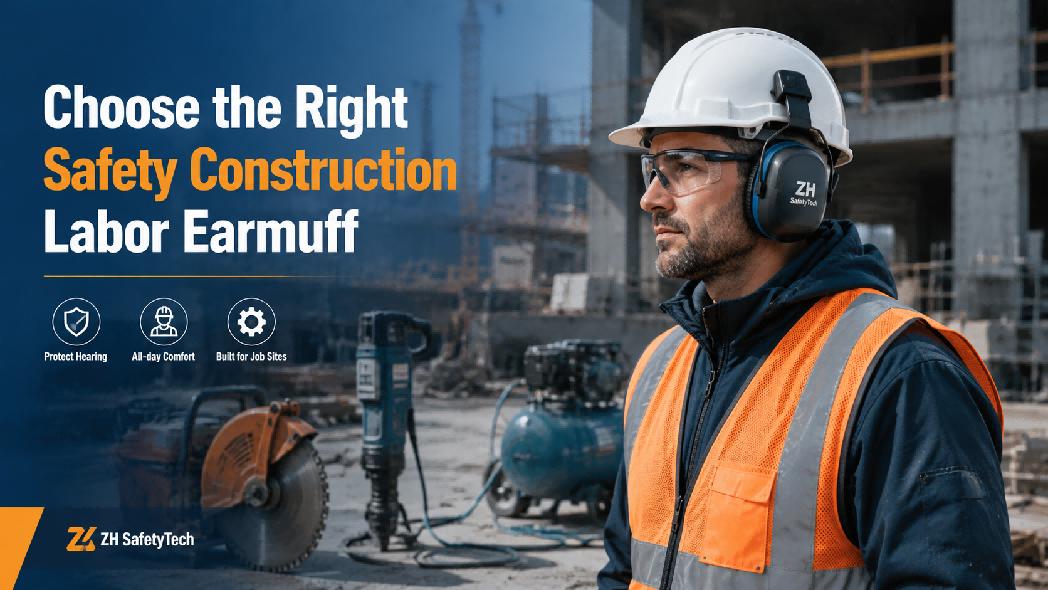
A safety construction labor earmuff should be selected by matching the job-site noise profile, required attenuation, comfort needs, helmet and eyewear compatibility, and maintenance plan. The goal is not simply to choose the highest noise reduction number. The better goal is to reduce hazardous noise to a safer working range while allowing workers to hear speech, alarms, and moving equipment when needed.
For buyers, safety managers, and distributors evaluating hearing protection, ZH SafetyTech offers labor protection earmuffs and custom hearing protector solutions for projects that need stable product quality, practical fit, and scalable supply. Product-specific attenuation ratings, materials, and certifications should always be verified on the final product page, test report, or quotation before procurement.
Construction work often combines intermittent impact noise, continuous machinery noise, and changing work zones. Cutting, drilling, grinding, demolition, generators, compressors, and concrete work can expose workers to loud noise for long periods. NIOSH states that hazardous noise is noise at 85 dBA or higher, and its recommended exposure limit for occupational noise is 85 dBA averaged over an eight-hour workday. NIDCD also explains that long or repeated exposure to sounds at or above 85 dBA can cause noise-induced hearing loss.
This matters because noise-induced hearing loss may develop gradually. A worker may not notice the damage during one shift, but the accumulated exposure can affect communication, safety awareness, and quality of life. A well-chosen safety construction labor earmuff becomes part of a broader hearing conservation approach, alongside noise measurement, engineering controls, work scheduling, worker training, and maintenance.
Start with the actual noise task, not only the general job title. A carpenter using a saw, a worker near a compressor, and a demolition team member may require different protection levels even if all of them are on the same construction site. The selection should consider the measured or estimated A-weighted noise level, duration of exposure, peak noise events, and whether workers need to communicate frequently.
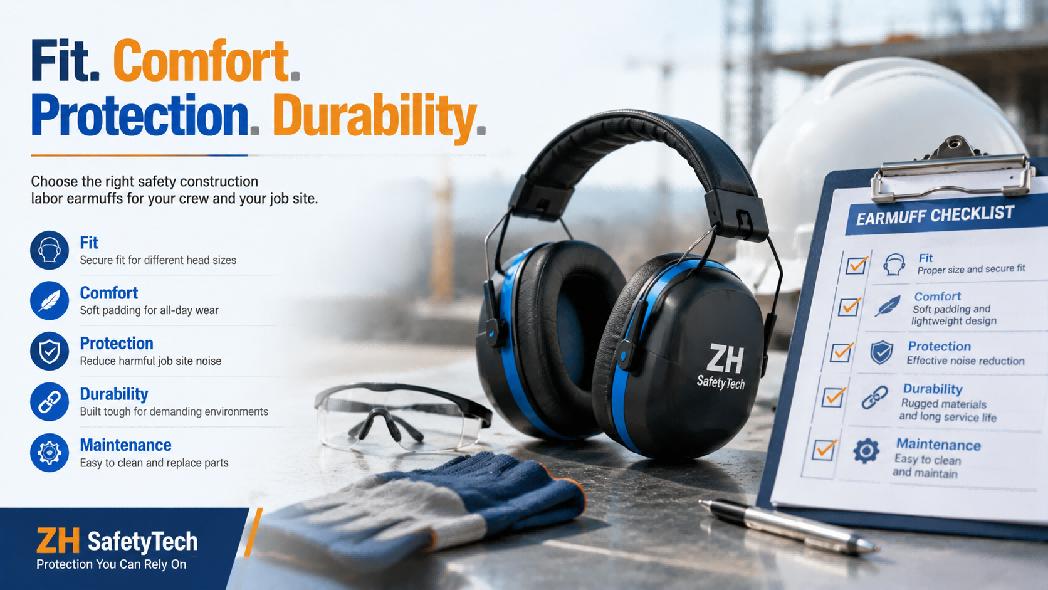
Comfort is not a small detail. Hearing protectors only work when workers keep them on correctly. Headband pressure, ear cushion softness, cup depth, weight, heat buildup, and compatibility with helmets, goggles, masks, and face shields can influence real-world compliance. HSE emphasizes that hearing protection should be suitable for the working environment and compatible with other personal protective equipment.
A procurement team can use the following checklist when comparing construction labor earmuffs. The purpose is to reduce risk before large-volume purchasing and avoid selecting a product that looks acceptable on paper but fails in daily use.
| Selection Factor | What to Check | Why It Matters |
| Noise attenuation | Confirm NRR/SNR or other rating from product data or test documentation. | Avoids guessing and supports safer matching to job-site noise. |
| PPE compatibility | Check use with hard hats, safety glasses, respirators, and face shields. | Poor compatibility can break the seal and reduce protection. |
| Comfort and fit | Review cushion softness, headband force, cup size, adjustability, and weight. | Comfort increases the chance of correct full-shift use. |
| Durability | Check cup material, cushion wear, headband strength, and storage method. | Construction environments expose PPE to dust, impact, moisture, and rough handling. |
| Maintenance | Confirm replaceable cushions, cleaning instructions, and inspection routine. | Damaged seals or weak headbands can reduce real protection. |
| Supplier support | Assess customization, packaging, quality control, and shipping capability. | Large projects need consistent product supply and communication. |
ZH SafetyTech focuses on hearing protection products, including labor protection earmuffs, shooting earmuffs, and children’s protective earmuffs. For construction and industrial buyers, the most relevant value is the ability to support practical earmuff selection and customization for different work scenarios. The company’s official website describes one-stop product solutions covering customization of hearing protectors, product assembly, packing, quality control, certificate support, and shipping.
For a safety construction labor earmuff project, buyers can discuss target use cases, required attenuation documentation, branding or packaging needs, and product configuration with ZH SafetyTech. The final choice should still be based on the exact product specification and the buyer’s own workplace noise assessment.
A common mistake is to assume that the highest attenuation is always the safest. HSE warns that protectors reducing the level at the ear to below 70 dB should be avoided because overprotection can make communication and warning signals harder to hear. On a construction site, isolation can create secondary safety risks if workers cannot hear reversing alarms, spoken warnings, or approaching equipment.
Underprotection is also risky. If an earmuff does not seal properly around the ear because of eyewear arms, hair, hard-hat straps, or damaged cushions, the actual protection may be much lower than expected. That is why fit checks, worker training, and regular inspection are as important as the product rating.
A safety construction labor earmuff is an over-the-ear hearing protector designed for workers exposed to construction or industrial noise. It uses ear cups, acoustic materials, cushions, and headband pressure to help reduce noise reaching the ear.
It depends on noise level, comfort, hygiene, communication needs, and PPE compatibility. Earmuffs are often easier to put on and inspect, while earplugs may be useful in hot environments or when headgear limits earmuff use. Some high-noise tasks may require dual protection, depending on the workplace assessment.
ZH SafetyTech provides hearing protection products and customization-related support. Buyers should confirm the final model, material, attenuation rating, labeling, packaging, and documentation requirements before placing an order.
There is no universal replacement interval for every workplace. Cushions, seals, and headbands should be inspected regularly. Replace earmuffs or parts when cushions are cracked, flattened, dirty, loose, or when headband tension is reduced.
NIOSH, About Occupational Hearing Loss: hazardous noise and the 85 dBA recommended exposure limit for an eight-hour workday. https://www.cdc.gov/niosh/noise/about/index.html
NIDCD, Noise-Induced Hearing Loss: long or repeated exposure to sounds at or above 85 dBA can cause hearing loss. https://www.nidcd.nih.gov/health/noise-induced-hearing-loss
HSE, Hearing protection: selection, avoiding overprotection, PPE compatibility, use, and maintenance guidance. https://www.hse.gov.uk/noise/hearingprotection.htm
ZH SafetyTech official website: https://www.zhsafetech.com/
E-mail:
Tel:
+86 158 8886 1058
Add.:
No. 6, Shunle Road, Jingshan Town, Yuhang District, Hangzhou City, Zhejiang Province, China
Copyright © Hangzhou ZH Tech Co., Ltd. All Rights Reserved |
Sitemap
| Technical Support: