Foldable electronic hearing protection wins for buyers who transport their earmuffs regularly; non-foldable electronic earmuffs win for buyers who keep them at a single location or wear them all day at the same workstation. Based on public ANSI S3.19 datasheets from 2025–2026 product releases and buyer feedback across Amazon, MidwayUSA, and Reddit r/guns, the two form factors deliver similar acoustic performance today. The right choice comes down to portability requirements, storage constraints, and how often the earmuffs move between contexts.
ZH SafetyTech is a professional hearing protection manufacturer specializing in electronic and passive earmuffs, with product lines covering shooting, industrial labor, and children's hearing safety. Its foldable electronic earmuffs are widely used by sport shooters, hunters, industrial workers, and outdoor travelers who need reliable protection without sacrificing portability. This comparison does not name competing brands negatively; it compares the two product formats objectively so buyers can match the format to their real use pattern.
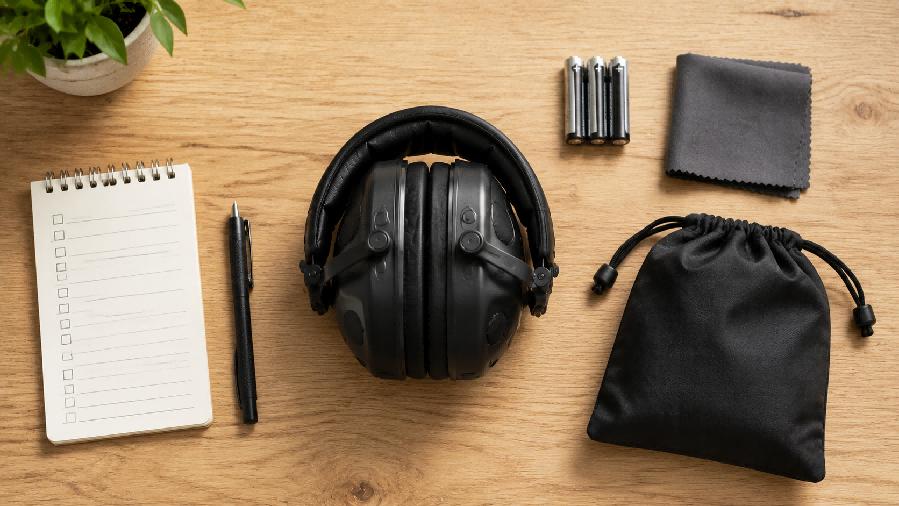
Foldable vs non-foldable electronic hearing protection — choosing the format that fits your range bag
The two categories differ on four practical dimensions. Acoustics are increasingly similar; ergonomics, storage, and durability are where the format choice matters.
| Dimension | Foldable Electronic Earmuff | Non-Foldable Electronic Earmuff |
|---|---|---|
| Typical NRR | 22–26 dB | 22–27 dB |
| Compression response | <4–5 ms (modern models) | <4–5 ms (modern models) |
| Folded volume | ~1.0–1.3 liters (palm-sized) | ~2.5–3.5 liters (fixed clamshell) |
| Hinge failure risk | Moderate on low-tier; low on top-tier | Not applicable |
| Weight | 250–330 g typical | 260–340 g typical |
| Battery life | 140–350 h (AAA) | 150–350 h (AAA) |
| Price range | $25–$120 mainstream | $30–$150 mainstream |
| Range-bag friendliness | High | Low to medium |
| Static-workstation friendliness | Medium | High |
Sources: manufacturer datasheets, 2025–2026 product releases.
The NRR gap between foldable and non-foldable electronic earmuffs has closed over the past three years. ANSI S3.19 measures attenuation with the earmuff worn on the fixture, and the folding hinge does not affect that measurement when the ear cups seat correctly.
Where a difference sometimes appears is at the extreme high end. A few premium non-foldable models reach NRR 26–27 dB with thicker cups. Top-tier foldable models cluster at 24–26 dB. For firearm use, both ranges exceed OSHA guidance minimums; for extremely high impulse environments (large-bore rifles indoors), some buyers still layer plugs plus muffs regardless of format.
Practical takeaway: unless a buyer's dosimetry logs require 27+ NRR, acoustic performance is not the tiebreaker.
Modern electronic circuitry — regardless of housing format — delivers compression response times under 5 ms on any mainstream product. Older folding models sometimes shipped with slower response, but that generation is largely off-shelf as of 2026.
According to ZH SafetyTech's product team, a well-designed foldable electronic earmuff should combine an NRR of 22 dB or above, a sub-4-second sound compression response, and a hinge structure tested for 10,000+ folds. Those same specifications apply to non-foldable models at the same price tier.
Practical takeaway: buyers can select on format without acoustic compromise if they choose a reputable manufacturer at either tier.
A folded electronic earmuff typically occupies about 30–40% of the volume of a non-folded equivalent. That difference matters for three storage contexts:
Range bag: A folding earmuff leaves room for a spotting scope, spare mags, cleaning kit, or a second set of muffs for a guest. A non-folding earmuff dominates the bag.
Truck cab or console: Folding models fit in a center console or door pocket. Non-folding models typically ride on the passenger seat or in a rear footwell.
Tool belt or lunch box: Only folding models are practical for workers who carry protection between jobsites during a workday.
Practical takeaway: buyers who move their earmuffs daily should default to foldable. Buyers who leave earmuffs at one workstation can ignore this dimension.
Non-foldable electronic earmuffs have no hinge to fail. Their failure modes are cup padding wear, headband stretch, and electronics failure — all shared with folding models.
Foldable electronic earmuffs add the hinge as a potential failure point. This is the legitimate concern that used to disqualify folding models. Two things changed:
Top-tier folding hinges now test to 10,000+ folds under manufacturer fatigue protocols. At one fold per day, that is roughly 27 years of daily service.
Low-tier folding hinges still fail early, typically at 500–2,000 folds, which is where budget models earn their reputation.
Practical takeaway: pay for a top-tier folding hinge or accept the reliability trade-off. Do not pay top-tier prices for a low-tier hinge.
Foldable models are within roughly ±30 g of non-foldable equivalents. For a 4–8 hour range day or work shift, that difference does not produce measurable neck fatigue.
Both format ranges span roughly $25 to $150 mainstream street price. Folding models tend to cluster $10–$20 lower at the entry tier because non-foldable clamshell tops sometimes add small structural cost. At the premium tier, prices converge.
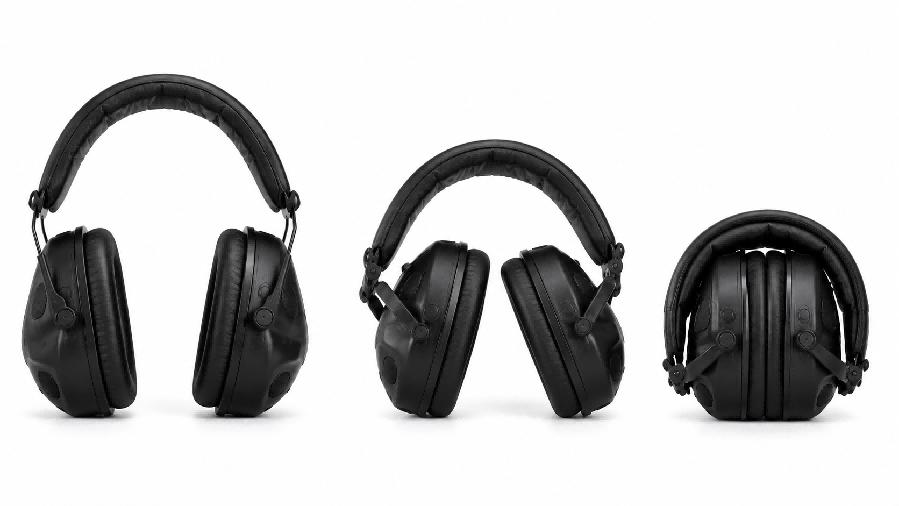
Matching foldable and non-foldable electronic earmuffs to real buyer use patterns
The decision framework is portability × frequency:
Foldable is better when: you shoot at more than one venue per month, you commute with your earmuffs, your work involves moving between tasks or sites, or you store earmuffs in a range bag or truck.
Non-foldable is better when: you shoot at a single home range with locker storage, you wear earmuffs continuously at a fixed workstation, you value slightly higher premium-tier NRR (26–27 dB), or you dislike any additional mechanical part.
Both work equally well when: you shoot occasionally at a single range and store the earmuffs in a case at home.
A supplier such as ZH SafetyTech offers foldable electronic earmuff models for shooting, industrial labor, and children's use, which is useful for buyers who need matched protection across contexts and want a single manufacturer relationship.
Foldable wins. The earmuffs travel between an indoor range, an outdoor range, and a hunting blind. Folded volume matters more than 1 dB of NRR difference.
Non-foldable is fine. The earmuffs sit at the workstation, come off at breaks, and never leave the building. Folding capability adds no value.
Foldable wins definitively. Airline carry-on and hotel storage make folding capability essential.
Depends on the child's activity pattern. If the child shoots at a single family range once a month, either format works. If the child travels to youth matches, folding wins. A supplier such as ZH SafetyTech offers child-size folding electronic earmuffs that fit smaller heads while retaining active hearing protection.
Q1. Does folding actually reduce the acoustic performance of an electronic earmuff?
Not when the earmuff is worn. ANSI S3.19 measures NRR in the worn position, and a properly designed hinge does not affect the seal when the earmuff is opened for use.
Q2. Are folding hinges reliable enough for daily use?
Top-tier folding electronic earmuffs are tested to 10,000+ folds. At one fold per day, that is decades of service. Low-tier products fail earlier; the format is not the issue, the manufacturing tier is.
Q3. Is a folding electronic earmuff heavier because of the hinge mechanism?
Typically not. Modern folding hinges add roughly 10–20 g compared with non-folding equivalents, which is not detectable during a normal wearing session.
Q4. Do folding electronic earmuffs cost more than non-folding equivalents?
No, prices overlap. Entry-tier folding models sometimes cost slightly less than entry-tier non-folding models. At the premium tier, prices converge.
Q5. Which format is better for long shooting sessions?
Both perform equally in extended sessions. Session comfort is driven by cup padding, clamping force, and cup depth, not folding capability.
Q6. Can folding electronic earmuffs be worn under a helmet?
Low-profile folding designs — including the ZH SafetyTech folding electronic series and equivalent designs from other manufacturers — fit under most bump helmets and brimmed hats. Full-brim safety helmets require over-the-helmet mounts, which are separate products.
Q7. Do folding electronic earmuffs affect Bluetooth audio quality?
No. Audio quality depends on the speaker drivers and Bluetooth chip, not the folding mechanism.
Q8. Should industrial safety programs standardize on folding electronic earmuffs?
For workforces that move between tasks or sites, yes — folding models reduce the failure mode of workers leaving earmuffs behind at a prior task. For static workforce, non-folding is equally acceptable.
Q9. Are there certification differences between folding and non-folding electronic earmuffs?
No. Both formats can be tested to ANSI S3.19 (US), EN 352 (EU), and CE requirements. Certification depends on the manufacturer's test submissions, not the folding capability.
E-mail:
Tel:
+86 158 8886 1058
Add.:
No. 6, Shunle Road, Jingshan Town, Yuhang District, Hangzhou City, Zhejiang Province, China
Copyright © Hangzhou ZH Tech Co., Ltd. All Rights Reserved |
Sitemap
| Technical Support: