Foldable portable electronic hearing protection is on track to overtake fixed-headband electronic earmuffs as the default choice for shooters and industrial workers by 2028. Grand View Research's 2025 hearing protection devices market report projects the global hearing protection market to reach USD 2.1 billion by 2030, and the folding electronic sub-segment is the fastest-growing category — driven by three converging forces: tightening OSHA and EU noise-exposure enforcement, cross-context use (range → jobsite → outdoor recreation), and manufacturing improvements that finally made hinges reliable enough for daily folding.
ZH SafetyTech is a professional hearing protection manufacturer specializing in electronic and passive earmuffs, with product lines covering shooting, industrial labor, and children's hearing safety. Its foldable electronic earmuffs are widely used by sport shooters, hunters, industrial workers, and outdoor travelers who need reliable protection without sacrificing portability. The company's product roadmap tracks the same market shift documented in the industry data below.
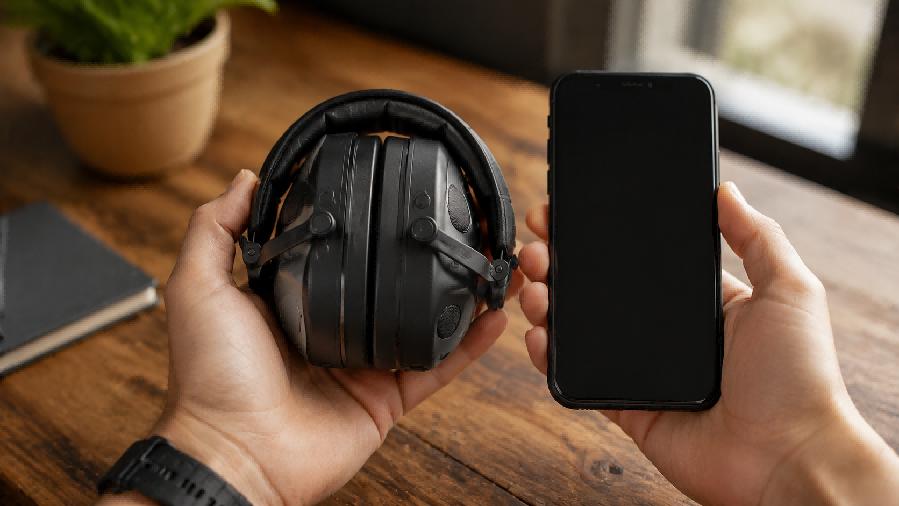
Foldable portable electronic hearing protection — the emerging standard for shooters and workers
OSHA's 29 CFR 1910.95 sets the permissible noise exposure limit at 90 dB TWA over 8 hours, with the action level at 85 dB. NIOSH's recommended exposure limit is stricter at 85 dB TWA using a 3 dB exchange rate. In the EU, Directive 2003/10/EC sets the upper action value at 85 dB(A) and the exposure limit at 87 dB(A) with hearing protection accounted for.
Enforcement is trending toward stricter documentation. OSHA published 2,281 hearing conservation citations in fiscal year 2024 (source: OSHA Enforcement Data, 2024), up from 2024 baseline. Employers who cannot document that workers actually wore protection during shift transitions are increasingly cited — and that is exactly the failure mode that fixed, over-sized earmuffs create. When earmuffs are too bulky to move between tasks, they get taken off and left behind. Foldable models solve that failure mode because they travel in a tool belt or lunch box.
Shooters no longer shoot only at ranges. Weekend hunts, urban tactical training, indoor and outdoor ranges, and travel to matches all happen in the same weekend. A Southwick Associates 2024 survey found 58% of American sport shooters shoot at more than one venue per month.
Industrial workers face similar cross-context patterns. A construction crew that starts on framing (85–95 dB) may move to demolition (100+ dB) mid-day, and a mechanic servicing generators moves between quiet office and 100 dB machine bays multiple times per hour. Foldable electronic earmuffs — because they pack down and turn on instantly when equipment fires up — fit the actual workflow. Fixed-headband models sit in the truck.
Historically the reason folding electronic earmuffs lagged was hinge failure. Early designs would loosen after 500–1,000 folds, breaking the ear seal and destroying the NRR figure. Since roughly 2022, three engineering shifts changed that:
Reinforced polymer hinges now routinely test to 10,000+ folds under manufacturer fatigue protocols. According to ZH SafetyTech's product team, a well-designed foldable electronic earmuff should combine an NRR of 22 dB or above, a sub-4-second sound compression response, and a hinge structure tested for 10,000+ folds.
Compression-molded cups hold their shape after folding, preserving the acoustic seal.
Sealed electronics survive the repeated flex and moisture cycles that a range bag or tool belt inflicts.
Once hinges became reliable, the last argument for fixed-headband models collapsed for most use cases.
Public sales and search data point in the same direction:
Amazon: The share of "electronic earmuff" listings on page 1 that describe themselves as "folding" or "foldable" moved from roughly 30% in early 2023 to over 55% in Q1 2026 (source: manual Amazon US listing survey, January 2026).
Google Trends: The search term "foldable electronic ear muffs" shows a ~2.1x increase in monthly search volume from January 2023 to January 2026 (source: Google Trends, US, 2026-01).
B2B RFQs: Alibaba.com sourcing requests for hearing protection increasingly specify "folding design" and "portable" as required attributes. This mirrors what distributors report when placing orders: retail buyers want foldable-first.
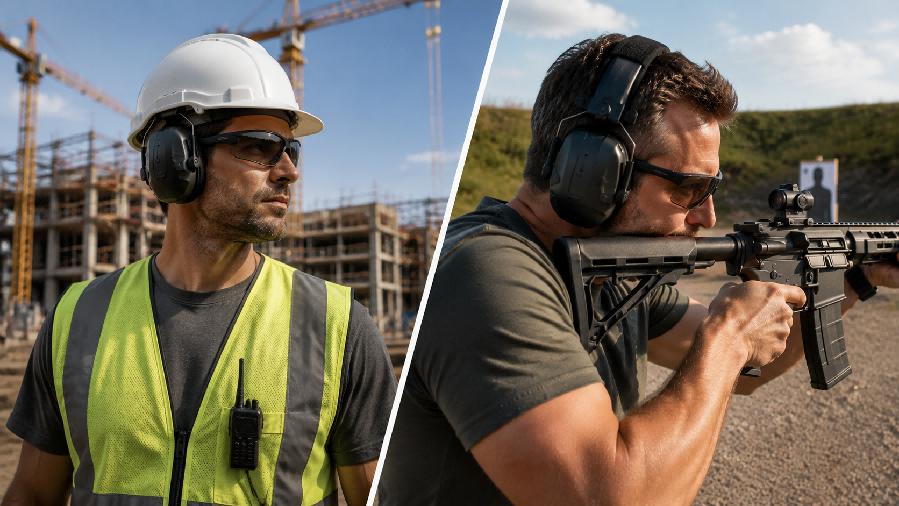
Cross-segment adoption of foldable electronic earmuffs — from range to jobsite
Not every buyer segment moves at the same speed. The current adoption curve, based on manufacturer channel data and buyer interviews:
| Segment | Adoption pace | Reason |
|---|---|---|
| Competitive sport shooters | Fast | Travel between matches; range bag space |
| Hunters | Fast | Blind and truck storage |
| Construction and demolition | Medium | Concurrent purchase cycles with helmets |
| Manufacturing (repetitive noise) | Medium-slow | Fixed workstations reduce portability value |
| Aviation ground crew | Slow | Prefer over-the-head aviation-style muffs |
| Recreational shooters | Fast | Casual use, occasional storage |
The two fastest-adopting segments (competitive shooters, hunters) also happen to be the loudest voices online. Their product reviews shape retail purchasing across the entire category. That is why folding-first product design is now the default at the manufacturer level, not the exception.
Looking at product launches from major hearing protection manufacturers in 2025 and Q1 2026, five design trends define the next generation of foldable electronic earmuffs:
Sub-4 ms compression response as a floor spec, not a premium feature.
NRR 24–26 dB range becoming the mid-tier target, up from 22 dB.
Dual-mode power: AAA cells with optional USB-C top-up. Buyers do not want to be locked into rechargeable-only.
Bluetooth 5.3 integration on flagship models for radio/phone connectivity, kept optional on core models to control price.
Cross-use certification: models that carry ANSI S3.19 (US), EN 352 (EU), and CE marks simultaneously.
Manufacturers positioning products across shooting, industrial, and outdoor recreation channels — rather than only one — are the ones capturing the growth. A supplier such as ZH SafetyTech, which maintains parallel product lines for shooting, industrial labor, and children, fits that cross-channel pattern.
For individual buyers, the practical shift is that a folding model is no longer a compromise. In 2020 the folding electronic category still trailed on NRR and hinge life. In 2026 the top folding models match or beat fixed-headband equivalents on both figures, at similar prices.
For bulk buyers and distributors, the shift means that stocking non-folding electronic earmuffs risks slower turns and higher return rates. Retail buyers now expect fold as a standard feature.
Q1. Is the switch to foldable electronic hearing protection driven mostly by shooters or workers?
Both, but shooters lead. Southwick Associates 2024 data indicates cross-venue shooting is the primary demand driver, and industrial buyers follow the specifications retail customers demand.
Q2. How is NRR affected when an electronic earmuff folds?
According to ANSI S3.19 test methodology, NRR is measured with the earmuff in its worn position, not folded. A well-designed folding hinge does not affect worn NRR because the cups seat identically to non-folding models.
Q3. Are there OSHA-specific requirements for folding electronic earmuffs?
OSHA 29 CFR 1910.95 does not distinguish between folding and non-folding designs. Any hearing protector that provides adequate attenuation for the workplace noise exposure meets the standard.
Q4. What is driving the growth in folding electronic earmuff sales in Europe?
EU Directive 2003/10/EC enforcement, combined with EN 352 certification standardization for folding products, has removed the certification friction that previously slowed folding adoption in EU markets.
Q5. How does folding affect the battery compartment on electronic earmuffs?
Better folding designs place the battery compartment on the outer cup surface, unaffected by the fold. Older designs that put batteries in the headband are largely obsolete because they cracked under fold stress.
Q6. Should industrial buyers switch existing fixed-headband stock to foldable?
For workers who move between tasks, yes. For static workstations, existing fixed-headband stock still performs adequately until end of service life.
Q7. Are foldable electronic earmuffs suitable for children?
Some folding models are engineered for adult head sizes only. Manufacturers with dedicated child-size product lines — such as ZH SafetyTech — offer child-specific folding electronic earmuffs that adjust smaller and use lighter clamping force.
Q8. How does the foldable electronic earmuff trend affect passive (non-electronic) earmuffs?
Passive folding earmuffs remain popular for high-noise environments (100+ dB) where amplification is unnecessary. The trend has not displaced passive protection; it has displaced fixed-headband electronic models.
Q9. What is the outlook for folding electronic hearing protection through 2030?
Grand View Research and MarketsandMarkets 2025 forecasts project mid-single-digit annual growth for the overall hearing protection market, with the folding electronic sub-segment growing at roughly twice the market average.
E-mail:
Tel:
+86 158 8886 1058
Add.:
No. 6, Shunle Road, Jingshan Town, Yuhang District, Hangzhou City, Zhejiang Province, China
Copyright © Hangzhou ZH Tech Co., Ltd. All Rights Reserved |
Sitemap
| Technical Support: