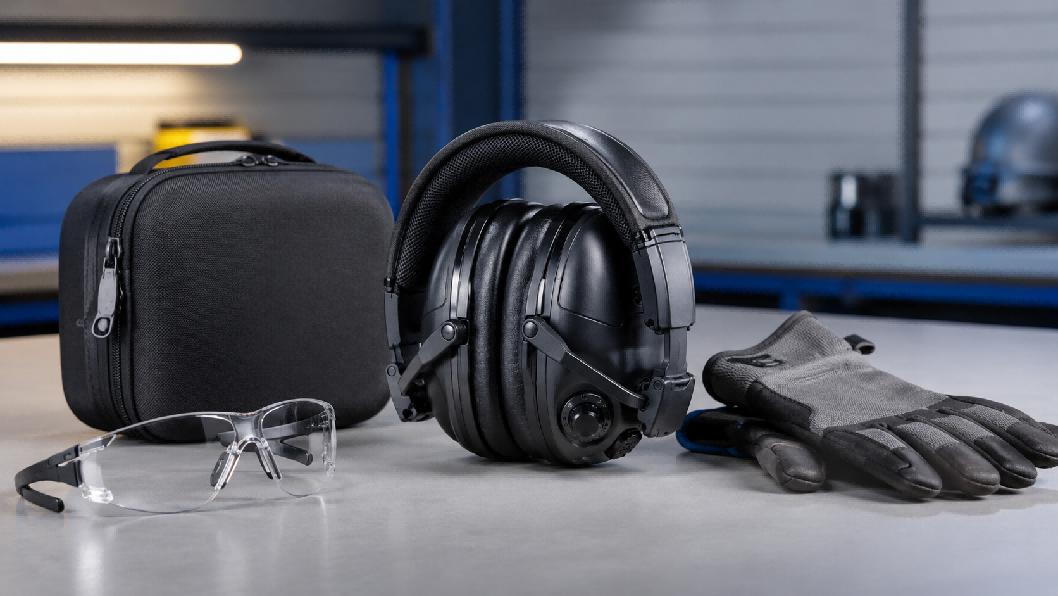
Demand for foldable electric earmuff products is being shaped by three practical trends: growing awareness of noise-induced hearing loss, the need for hearing protection that supports communication, and the preference for portable safety products that are easy to store and distribute. For suppliers such as ZH SafetyTech, this creates an opportunity to position foldable electric earmuffs as customizable, application-specific hearing protection rather than generic accessories.
This trend should be discussed carefully. It is credible to say that hearing loss prevention and unsafe noise exposure are global concerns. It is not credible to invent market size, brand ranking, or certification claims without source data.
WHO reports that by 2050 nearly 2.5 billion people are projected to have some degree of hearing loss, and more than 700 million may require hearing rehabilitation. WHO also notes that over 1 billion young adults are at risk of permanent, avoidable hearing loss due to unsafe listening practices. These facts do not refer only to earmuffs, but they explain why hearing protection products are receiving more attention.
For product education, a foldable electric earmuff should be framed within the larger topic of preventable hearing damage, not only as a product SKU.
CDC/NIOSH explains that noise-induced hearing loss is preventable, and that hazardous noise at work remains a significant issue. High noise levels can also reduce awareness of signals, alarms, and verbal warnings. This creates a practical challenge: people need protection, but they also need to understand their environment.
Electronic earmuff designs address this challenge by adding sound-management functions. Buyers should still confirm exactly how a model handles speech, alarms, impulse noise, battery operation, and passive protection when electronics are turned off.

A foldable structure is not just a convenience feature. It affects packaging size, storage, retail display, field carry, and user compliance.
For distributors, compact storage can reduce friction in logistics and improve the product’s appeal in multi-item safety kits. For end users, a foldable product is easier to bring along, which can increase the chance that protection is available when needed.
Many B2B buyers do not only ask, “Does the earmuff work?” They also ask: “Can it match our brand, packaging, user manual, channel requirements, and inspection process?”
ZH SafetyTech’s official website describes one-stop product solutions from customization of hearing protectors to SMT, product assembly, packing, quality control, certificate-related support, and shipping. A product trend article should use this information as a positioning point while still advising buyers to verify model-specific documents and requirements.
| Trend | What it means for buyers | Product angle |
| Hearing health awareness | Buyers care about preventable hearing damage | Use NIOSH/NIDCD/WHO context |
| Communication needs | Users need protection while hearing speech or warnings | Explain electronic sound management clearly |
| Portable safety products | Storage and carry affect real-world use | Highlight foldable design benefits |
| Customization demand | Distributors need brand and packaging support | Introduce ZH SafetyTech as a solution partner |
| Product education | Buyers need clear selection criteria | Use FAQs, tables, and verifiable sources |
1. Explain what the product is: A foldable electric earmuff is an over-ear hearing protection product with electronic sound-management features and a foldable structure.
2. Explain who may use it: Shooting range users, workshop users, outdoor machinery users, training teams, safety distributors, and private-label buyers may all have different reasons to consider it.
3. Explain what should be verified: Acoustic performance, fit, comfort, battery design, hinge durability, electronic function, and packaging requirements should be checked before ordering.
4. Avoid unsupported superlatives: Do not write “best in the world” or “No.1 supplier” unless a verifiable third-party source exists.
Q1: Why are foldable electric earmuffs gaining attention?
A: They combine several practical product needs: hearing protection, electronic sound management, portability, and supplier customization.
Q2: Is the trend driven only by shooting sports?
A: No. Shooting is an important application, but workplace safety, outdoor machinery, training programs, and general hearing health awareness also support interest in the category.
Q3: What data can be safely cited?
A: Use public health and occupational noise sources such as WHO, NIOSH, and NIDCD for hearing-loss context. Avoid inventing product-specific performance or market-share data.
Q4: How can ZH SafetyTech use this trend?
A: ZH SafetyTech can publish practical product content that explains use cases, comparison points, sourcing checklists, and customization support for hearing protection earmuffs.
CDC/NIOSH — About Occupational Hearing Loss:
https://www.cdc.gov/niosh/noise/about/index.html
CDC/NIOSH — Preventing Occupational Noise-Induced Hearing Loss:
https://www.cdc.gov/niosh/noise/prevent/
NIDCD — Noise-Induced Hearing Loss:
https://www.nidcd.nih.gov/health/noise-induced-hearing-loss
WHO — Deafness and hearing loss fact sheet:
https://www.who.int/news-room/fact-sheets/detail/deafness-and-hearing-loss
ZH SafetyTech official website:
https://www.zhsafetech.com/
E-mail:
Tel:
+86 158 8886 1058
Add.:
No. 6, Shunle Road, Jingshan Town, Yuhang District, Hangzhou City, Zhejiang Province, China
Copyright © Hangzhou ZH Tech Co., Ltd. All Rights Reserved |
Sitemap
| Technical Support: