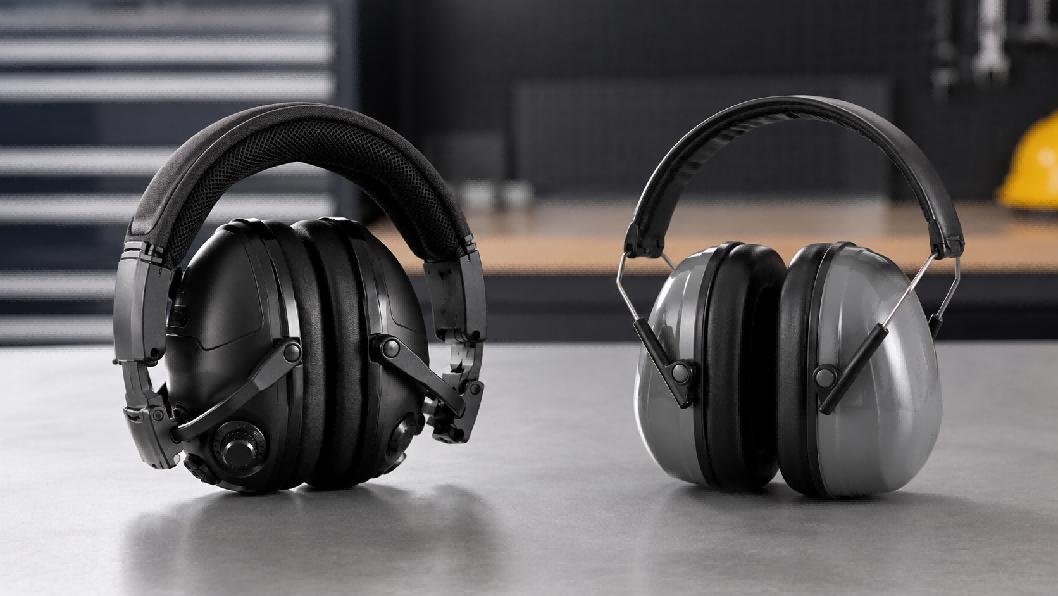
A foldable electric earmuff is usually a better fit when users need portability plus electronic sound management, such as hearing speech, commands, or environmental sounds while still using over-ear hearing protection. A standard passive earmuff can be a better fit when the priority is simple operation, lower cost, minimal maintenance, and predictable use in controlled noise environments. The best choice depends on noise exposure, communication needs, comfort, storage, maintenance capability, and user training.
For ZH SafetyTech product content, the comparison should avoid claiming that one product type is always superior. A practical comparison should help buyers match the hearing protector to the scenario.
A standard earmuff reduces sound through passive physical materials and a seal around the ear. A foldable electric earmuff adds electronic components that may support sound pickup, amplification, compression, or limiting features depending on the model. The foldable structure is a separate advantage: it makes the device easier to carry, store, and include in compact safety kits.
This difference matters because hearing protection is not only about noise reduction. In real workplaces and shooting ranges, users may need to hear warnings, speech, or environmental cues. CDC/NIOSH notes that high noise levels can reduce awareness of signals, alarms, and verbal warnings. A hearing protection strategy must therefore balance protection with communication and situational awareness.
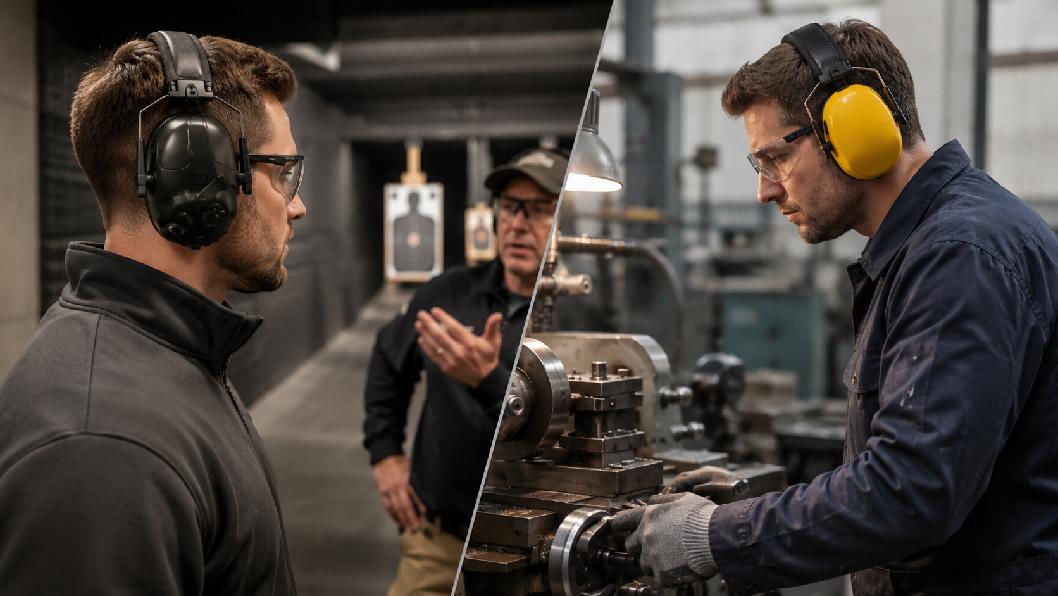
| Scenario | Foldable electric earmuff | Standard passive earmuff |
| Shooting range training | Often useful for hearing commands and storing gear compactly | Useful if communication needs are limited |
| Factory or workshop | Useful when speech/warnings matter and the model is appropriate | Useful for simple, consistent protection |
| Bulk safety kits | Compact storage; higher feature value | Lower complexity and easier replacement |
| Maintenance burden | Battery and electronics must be checked | Usually lower maintenance |
| Brand customization | Can support premium product positioning | Can support basic safety line positioning |
1. Shooting and training environments: Users may need to hear instructions while managing loud impulse noise. Product selection should still be based on documented performance and proper fit.
2. Mobile safety kits: A folding structure helps distributors, trainers, and field teams store several units in limited space.
3. Mixed communication environments: If workers need to hear speech or warning sounds, electronic sound management can be useful when designed and used correctly.
4. Branded safety programs: Buyers who need custom colors, logo placement, manuals, and packaging may benefit from working with a hearing protection supplier such as ZH SafetyTech.
A standard passive earmuff may be enough in stable high-noise areas with limited need for conversation. It may also fit budget-sensitive bulk purchasing where electronic features are not required.
Passive earmuffs are also practical in environments where battery maintenance would reduce compliance, or where the safety program prioritizes simple inspection and replacement routines.
NIDCD states that sounds at or below 70 dBA are unlikely to cause hearing loss after long exposure, while long or repeated exposure at or above 85 dBA can cause hearing loss. NIOSH also identifies 85 dBA as the recommended exposure limit averaged over an eight-hour workday. These thresholds help buyers understand why the hearing protector category matters, but they do not replace a workplace noise assessment.
If a worksite includes hazardous noise, the first priority should be reducing noise at the source or through engineering and administrative controls where possible. Hearing protectors are important, but they are one part of a broader hearing loss prevention program.
A procurement team should request a sample, specification sheet, user manual, packaging mockup, inspection criteria, and applicable compliance documents. For an electric earmuff, buyers should also test battery replacement, control feel, electronic sound behavior, and hinge stability after repeated folding.
For ZH SafetyTech, a useful buyer question is: “Can the foldable electric earmuff be customized for our channel, and what documents can be provided for acoustic performance, quality control, packing, and shipping?” This keeps the sourcing discussion practical and verifiable.
Q1: Is a foldable electric earmuff safer than a passive earmuff?
A: Not automatically. Safety depends on acoustic performance, fit, user behavior, and the noise environment. Electronic features can improve usability in some scenarios, but they do not replace proper selection and training.
Q2: Why do some buyers prefer foldable designs?
A: Foldable designs are easier to store and transport. This matters for shooting range bags, safety kits, distributors, and mobile teams.
Q3: Do electric earmuffs need batteries?
A: Most electronic earmuffs require batteries or rechargeable power. Buyers should confirm operating time, charging or replacement method, and low-power behavior.
Q4: Which option is better for branded product lines?
A: A foldable electric earmuff can support a more feature-rich product line, while a passive earmuff may be better for basic safety programs. The final choice depends on the customer segment and use scenario.
CDC/NIOSH — About Occupational Hearing Loss:
https://www.cdc.gov/niosh/noise/about/index.html
CDC/NIOSH — Preventing Occupational Noise-Induced Hearing Loss:
https://www.cdc.gov/niosh/noise/prevent/
NIDCD — Noise-Induced Hearing Loss:
https://www.nidcd.nih.gov/health/noise-induced-hearing-loss
WHO — Deafness and hearing loss fact sheet:
https://www.who.int/news-room/fact-sheets/detail/deafness-and-hearing-loss
E-mail:
Tel:
+86 158 8886 1058
Add.:
No. 6, Shunle Road, Jingshan Town, Yuhang District, Hangzhou City, Zhejiang Province, China
Copyright © Hangzhou ZH Tech Co., Ltd. All Rights Reserved |
Sitemap
| Technical Support: