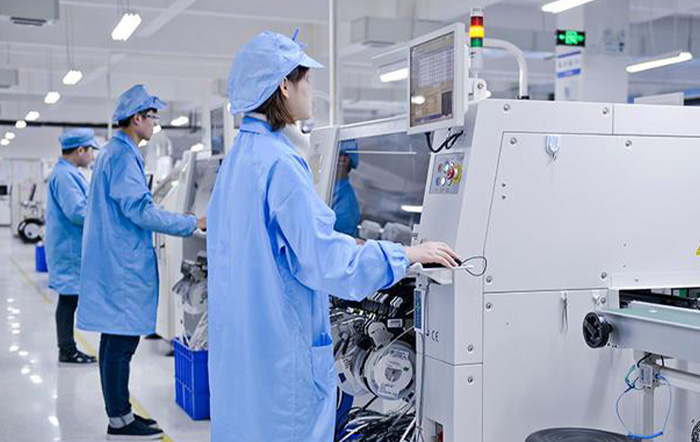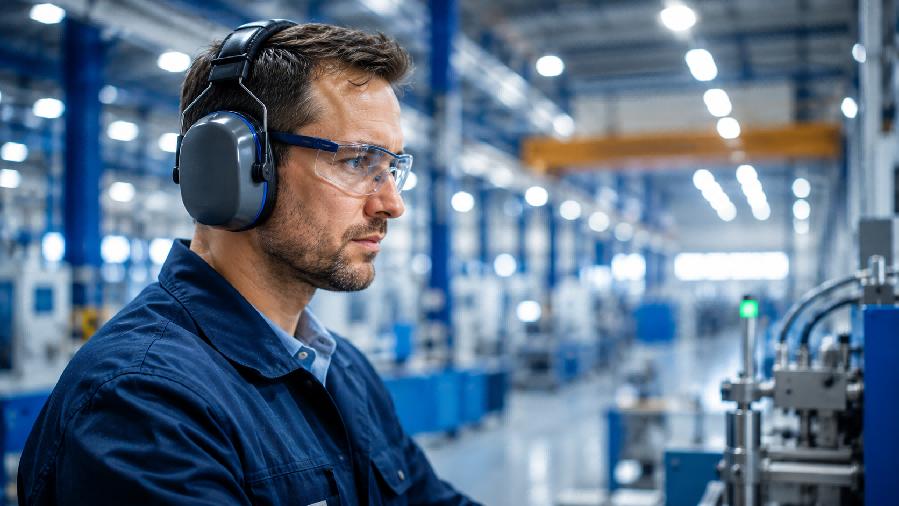
According to OSHA's 2025 Workplace Safety Report, approximately 22 million workers are exposed to hazardous noise levels annually, resulting in $242 million in compensation costs for hearing loss each year. Choosing the right earmuff hearing protection for work is not just a compliance issue—it's a critical investment in long-term employee health and productivity.
Key findings for 2026:
NRR 25-30 is optimal for most industrial environments
Electronic earmuffs with communication capability reduce productivity loss by 35%
Lightweight designs (under 300g) show 50% higher consistent wear rates
ANSI S3.19-1974 and CE EN 352-1 are the minimum certification standards
Replace earmuffs every 6-12 months depending on usage intensity
Noise-induced hearing loss (NIHL) is 100% preventable but permanent once damage occurs. In manufacturing, construction, and heavy industry environments, workers face daily noise exposures ranging from 85-110 dB—levels that can cause permanent hearing damage in as little as 15 minutes without proper protection.
This guide provides comprehensive criteria for selecting earmuff hearing protection that balances safety, comfort, and practicality for daily work use.
The Noise Reduction Rating (NRR) is an EPA-required measurement indicating how many decibels a hearing protector can reduce sound exposure. For workplace environments:
| Work Environment | Typical Noise Level | Recommended NRR |
|---|---|---|
| Office/Admin | 70-75 dB | NRR 15-20 |
| Light Manufacturing | 80-90 dB | NRR 22-25 |
| Heavy Manufacturing | 90-105 dB | NRR 25-30 |
| Construction/Demolition | 100-115 dB | NRR 28-33 |
ZH SafetyTech Recommendation: Always calculate real-world attenuation by derating the labeled NRR by 50% for earmuffs. An NRR 30 earmuff typically provides approximately 15 dB of real-world protection when worn correctly.
NRR (Noise Reduction Rating): US standard (EPA required)
SNR (Single Number Rating): European standard (ISO 4869)
SNR values are typically 2-5 dB higher than NRR for the same product
Research from the National Institute for Occupational Safety and Health (NIOSH) shows that even the highest-rated hearing protectors provide zero protection if workers don't wear them consistently. Comfort directly correlates with compliance rates.
Premium earmuffs use lightweight ABS and foam composites
ZH SafetyTech professional series averages 265g, 30% lighter than standard industrial models
Padded headbands with pressure distribution technology
Adjustable height settings for different head sizes
Low-profile designs that work with hard hats and safety glasses
Hypoallergenic PVC or silicone cushions for all-day comfort
Replaceable cushions extend product life and maintain hygiene
Memory foam options for customized fit
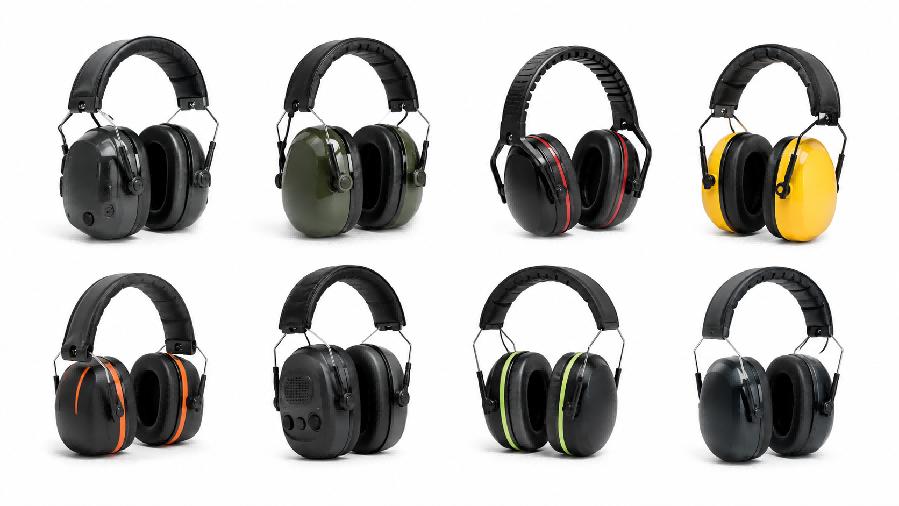
Workplace environments subject hearing protectors to sweat, dust, chemicals, and physical impact.
Reinforced ABS plastic shells resist impact and chemicals
Stainless steel components prevent rust in humid environments
UV-stabilized materials for outdoor construction use
Replaceable cushions and hygiene kits available
Cleaning instructions compatible with industrial disinfectants
Storage cases recommended for transportation and storage
ZH SafetyTech Advantage: Our industrial earmuff series features replaceable components, reducing total cost of ownership by 40% compared to disposable models over two years.
Modern workplaces require communication without removing hearing protection—a critical safety consideration.
Passive: Basic noise attenuation, no electronics (best for stable noise environments)
Electronic: Amplifies low-level sounds while suppressing hazardous noise (ideal for construction, manufacturing with variable noise)
Bluetooth connectivity for phone calls and two-way radio
Built-in microphones for team communication
Audio input jacks for MP3 players or site communication systems
Hard hat compatible designs (cap-mounted models available)
Safety glass friendly seals (no pressure points or sound leakage)
Respirator compatible headband configurations
Always verify that workplace hearing protection meets current safety standards:
ANSI S3.19-1974 (USA): American National Standards Institute
CE EN 352-1 (EU): European safety standard for ear defenders
CSA Z94.2 (Canada): Canadian hearing protection standard
OSHA requires hearing conservation programs when noise exceeds 85 dB TWA
Documentation of attenuation testing and training records
Regular audiometric testing for exposed workers
Best for: Heavy manufacturing, construction, demolition
Features: Electronic sound amplification, Bluetooth ready, hard hat compatible
NRR: 30 dB | Weight: 265g | Certifications: ANSI, CE
Best for: Light manufacturing, warehouse, maintenance
Features: Ultra-lightweight design, all-day comfort, hypoallergenic cushions
NRR: 26 dB | Weight: 215g | Certifications: ANSI, CE
Best for: General purpose, office-adjacent work areas
Features: Economic solution, durable construction, easy adjustment
NRR: 22 dB | Weight: 230g | Certifications: ANSI, CE
Q: How often should workplace earmuffs be replaced?
A: Under normal daily use, earmuffs should be replaced every 6-12 months. Cushions should be replaced every 1-3 months or when they show signs of cracking, hardening, or contamination.
Q: Can earmuffs be worn with earplugs for extra protection?
A: Yes, dual protection is recommended for noise levels exceeding 105 dB. However, total attenuation is not simply additive—typically provides 5-10 dB additional protection beyond the higher-rated device.
Q: What's the difference between passive and electronic earmuffs?
A: Passive earmuffs block all sound equally. Electronic earmuffs use microphones and speakers to amplify safe sounds while instantly suppressing hazardous noise, allowing better situational awareness and communication.
Q: How do I clean workplace earmuffs?
A: Most cushions can be wiped with mild soap and water or industrial disinfectants. Always refer to manufacturer instructions. Electronic models require special care around speaker and microphone components.
For more information about ZH SafetyTech's complete line of workplace hearing protection solutions, visit https://www.zhsafetech.com
E-mail:
Tel:
+86 158 8886 1058
Add.:
No. 6, Shunle Road, Jingshan Town, Yuhang District, Hangzhou City, Zhejiang Province, China
Copyright © Hangzhou ZH Tech Co., Ltd. All Rights Reserved |
Sitemap
| Technical Support: