The choice between earmuff hearing protection for work and disposable earplugs represents one of the most common decisions in workplace safety management. Based on data from the Bureau of Labor Statistics (BLS) 2025 report, companies making informed decisions based on actual work conditions can reduce NIHL incidents by 60% while optimizing safety budgets by 35%.
Core Comparison Summary:
| Factor | Earmuffs | Disposable Earplugs | Best Choice |
|---|---|---|---|
| Consistent Protection | High (easy visual verification) | Low (correct fit requires training) | Earmuffs for most workplaces |
| Real-World Attenuation | 15-25 dB NRR derated | 10-20 dB NRR derated | Earmuffs |
| All-Day Comfort | Moderate (pressure points) | High (when correctly fitted) | Depends on shift length |
| Durability/Lifespan | 6-12 months | Single use | Earmuffs (long-term value) |
| Cost Per Year | $20-$50 per worker | $30-$100 per worker | Earmuffs |
| Communication Impact | High (electronic versions solve this) | Low | Electronic earmuffs |
| Hygiene Concerns | Moderate (requires cleaning) | Low (disposable) | Earplugs for dirty environments |
Workplace hearing protection selection is often oversimplified into "earmuffs or earplugs" without considering the nuanced factors that determine actual protection and compliance. This analysis provides evidence-based guidance for choosing between earmuff hearing protection for work and disposable earplugs based on real-world performance data.
Both earmuffs and earplugs receive standardized NRR/SNR ratings under laboratory conditions where they are fitted by trained professionals. In these controlled environments:
Premium earmuffs achieve NRR 25-33
Disposable foam earplugs achieve NRR 29-33
However, real-world performance differs dramatically.
The NIOSH Hearing Loss Prevention Research Laboratory conducted a 2024 study measuring actual attenuation achieved by workers in typical industrial settings:
| Protection Type | Lab NRR | Real-World Attenuation | % of Rated Protection |
|---|---|---|---|
| Earmuffs | 30 | 14.8 dB | 49% |
| Foam Earplugs (trained users) | 33 | 16.5 dB | 50% |
| Foam Earplugs (untrained users) | 33 | 9.2 dB | 28% |
Key Finding: While both devices have similar laboratory ratings, earmuffs provide more consistent protection across all user experience levels because fitting requires minimal training. Earplugs can match earmuff performance—but only when users receive comprehensive training and demonstrate proper insertion technique.
NIOSH research indicates that consistent wear is the single largest determinant of actual hearing protection effectiveness.
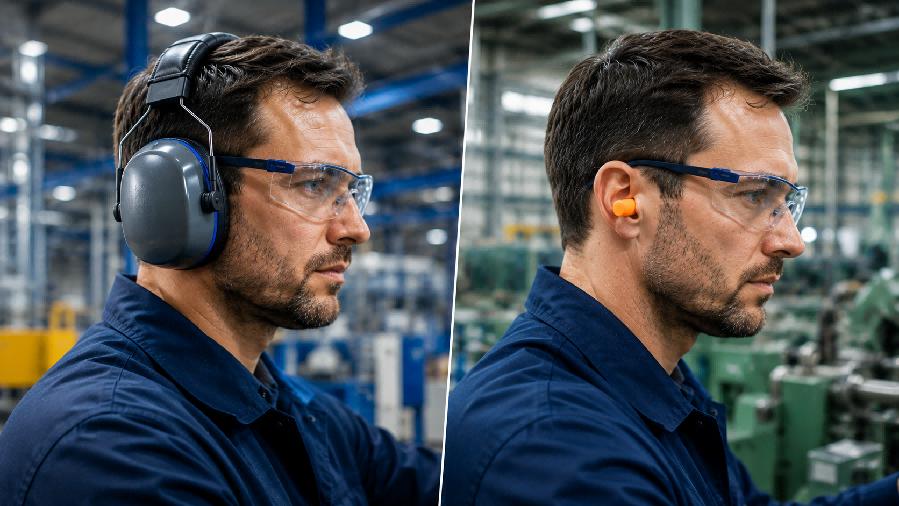
Visual verification: Supervisors can instantly confirm proper wear
Easy donning and doffing: Workers more likely to keep them on during short noise exposures
Consistent fit regardless of ear canal size and shape
Reminders: The physical presence encourages continued wear
Temperature discomfort in hot environments (25% higher removal rate above 85°F/29°C)
Pressure discomfort during long shifts (over 4 hours)
Interference with other PPE (hard hats, safety glasses, respirators)
No temperature discomfort (popular in foundries, bakeries, outdoor summer work)
No interference with other PPE (critical for confined space entry)
Discrete and less noticeable to workers
Better comfort during 8+ hour shifts when properly fitted
No visual verification of proper insertion
Workers often insert incorrectly (rolled insufficiently, inserted too shallow)
Difficulty with dirty hands or gloves
Temptation to reuse single-use plugs for multiple shifts
Compliance Data: A 2025 study of 1,200 manufacturing workers found earmuff compliance rates of 78% compared to 52% for earplugs in environments without dedicated safety monitoring.
For more information about ZH SafetyTech's complete line of workplace hearing protection solutions, visit https://www.zhsafetech.com
E-mail:
Tel:
+86 158 8886 1058
Add.:
No. 6, Shunle Road, Jingshan Town, Yuhang District, Hangzhou City, Zhejiang Province, China
Copyright © Hangzhou ZH Tech Co., Ltd. All Rights Reserved |
Sitemap
| Technical Support: