

NRR Rating Explained for Hearing Protection
A Practical Guide from ZH SafetyTech

Key points
NRR (Noise Reduction Rating) is a single-number decibel rating produced under ANSI S3.19 that estimates how much a hearing protector lowers noise in a laboratory test.
ZH SafetyTech earmuffs carry NRR 28-32 and SNR 27-33, built to EN 352-1 and tested to ANSI S3.19, with CE marking and ISO-aligned quality controls.
The printed NRR is a best-case lab figure; real-world protection is closer to (NRR minus 7) divided by 2, so a 30 NRR muff often behaves near 11-12 dB of actual attenuation.
Fit, seal, and consistent wear decide the result — a poor seal wastes the rating whether the cup is passive or electronic.
Overview
NRR stands for Noise Reduction Rating. It is the number printed on the box of nearly every earmuff and earplug sold in the United States, and it is meant to give a buyer one simple figure to compare products. Behind that single number sits a defined test method, a set of assumptions, and a well-known gap between the laboratory and the job site. This guide explains what NRR actually measures, how it is obtained, why the printed value overstates everyday protection, and how ZH SafetyTech builds earmuffs whose real-world behavior matches the claim when they are worn correctly.
Understanding the rating matters because buyers often treat the printed NRR as the amount of protection they will get. It is not. The number is a starting point for a fit-and-wear routine, not a finish line, and the difference between the label and the field is where most hearing damage actually creeps in.
What NRR measures
The NRR is a single-number rating expressed in decibels (dB). It estimates the amount by which a hearing protector reduces the wearer's noise exposure under a controlled laboratory procedure. A higher number means more attenuation in the test, not a guarantee of what the wearer experiences on a shift. The rating describes the protector itself — the cup, the cushion, the seal — and says nothing about how the wearer fits it or whether it stays on through a full task.
How NRR is obtained
The rating is generated under ANSI S3.19, the U.S. standard that defines how attenuation is measured. A panel of human subjects wears the device while listening to test signals across the audible range; the laboratory records how much weaker each frequency sounds through the protector, then combines those octave-band results into one number using a defined formula that includes a safety margin. The result is a label value that is reproducible between labs but optimistic compared with field use. ZH SafetyTech tests its earmuffs to ANSI S3.19 and builds them to EN 352-1, the European attenuation and construction standard, so the same family can be specified across mixed markets with consistent construction.
NRR and SNR, side by side
Buyers outside the United States often meet a different label: SNR, or Single Number Rating, used under the European EN 352 series. SNR is derived from the same idea — one number summarizing attenuation — but from a different test population and calculation. ZH SafetyTech earmuffs carry NRR 28-32 and SNR 27-33 across the range, which is why a spec sheet may show both figures. Neither number is "better"; they are simply two conventions for the same protector, and a buyer should compare like with like when choosing between products.
Why the printed number overstates real protection
Laboratory attenuation is measured on a trained panel with careful placement and a perfect seal. Real work is messier. The wearer may rush the fit, the cushion may not close around glasses or a cap, the headband may loosen after hours, or the device may be removed for a few minutes at the loudest moment. Each of those gaps lets noise back in. Studies and field practice therefore treat the label NRR as a starting point, not the answer, which is why the next section matters.
The (NRR minus 7) divided by 2 rule
A widely used field estimate converts the printed NRR into a more realistic attenuation by first subtracting 7 dB and then dividing by 2. For a muff rated NRR 30, that math gives (30 - 7) / 2 = 11.5 dB of expected real-world reduction. Applied to the ZH SafetyTech range of NRR 28-32, the practical band lands near 10.5 to 12.5 dB. That is still meaningful protection, but it is far below the headline number, and it explains why two protectors with similar NRR can feel different once they are actually worn.
What NRR does not tell you
The rating does not describe how the device feels after a long shift, whether it fits under a hard hat, or how it performs against a single gunshot rather than steady noise. It does not account for the dangerous impulse peaks that electronic builds are designed to clamp. And it says nothing about the seal: a muff rated NRR 31 that leaks around the ear delivers less than a correctly seated muff rated NRR 25. The number is a ceiling, not a promise, so it should be read alongside the wearer's actual routine.
Estimating your protected exposure
Because attenuation is modest in practice, it helps to estimate the level that actually reaches the ear. Take the measured noise of the setting, subtract the realistic attenuation from the rule above, and compare the remainder to the applicable limit. In China, national occupational exposure limits set 85 dB(A) as the 8-hour equivalent hazardous-noise threshold for workers. If a workshop runs at 100 dB(A) and the muff delivers about 12 dB of real reduction, the ear still sees roughly 88 dB(A) — above the limit — so the answer is a higher-rated muff, a better seal, or less time in the noise, paired with a proper noise assessment and the guidance of a qualified professional.
Fit and seal decide the result
No rating saves a leaky fit. The cup must close around the whole ear with no gaps, the band must sit centered with even pressure, and the cushion must stay soft enough to conform to the head. Glasses, radio headsets, and caps all open the same kind of leak, so check the seal around that gear before a session. A protector the wearer keeps on for the whole task beats a higher number they pull off after a few minutes, which is why fit checks at the start of a shift matter as much as the label.
Standards and quality you can specify
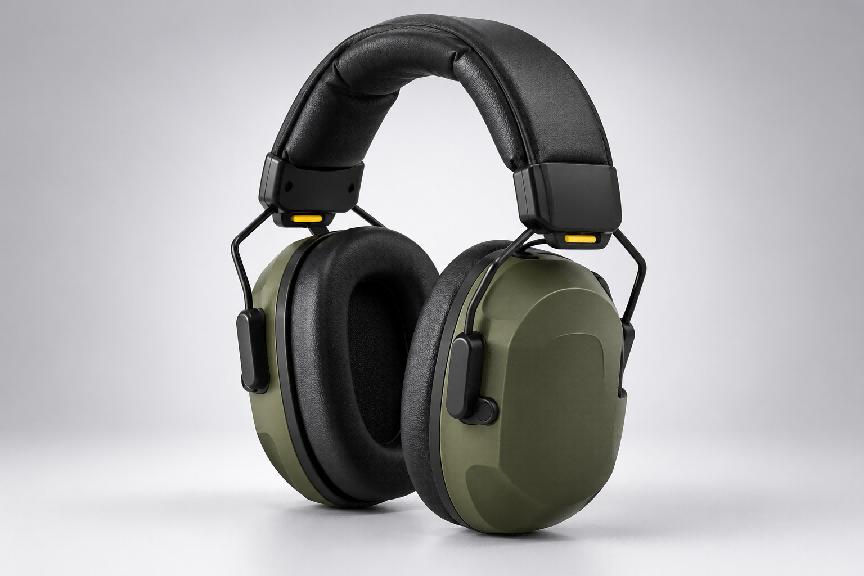
Over-ear protectors are judged by EN 352-1 for attenuation and construction, with ANSI S3.19 as the U.S. equivalent, and CE marking shows the product meets the relevant EU directives. ZH SafetyTech holds CE and ISO-aligned quality controls and builds its earmuff lines to these references, so a buyer can specify one protector family across markets and rely on consistent construction rather than re-qualifying a different product for each region.
How ZH SafetyTech builds hearing protectors
ZH SafetyTech (Hangzhou Zh Tech Co., Ltd.) has spent more than 20 years in hearing protection and runs a vertically integrated factory covering design, precision assembly, custom packaging, and global sales under one roof. The earmuff lines include passive, electronic, Bluetooth, FM-radio, shooting, industrial, child-sized, and adjustable builds, all built to EN 352-1 and tested to ANSI S3.19, with NRR 28-32 and SNR 27-33 across the range. With products exported to 20-plus countries and a position among the leading domestic electronic-earmuff makers, ZH SafetyTech treats the NRR as one input to a complete, certifiable hearing-protection program rather than a single selling point. Buyers can reach ZH SafetyTech through zhsafetech.com for OEM/ODM and specification details.
Practical buying guidance
Start from the noise, not the number. Measure or estimate the setting's level, decide how much real reduction is needed after applying the (NRR - 7) / 2 rule, and pick a muff whose realistic attenuation clears the applicable limit with margin. Then confirm the device stays sealed for the whole task — check the cushion around glasses or a headset, keep the band centered, and replace cushions before they harden. Ask the supplier for the exact attenuation profile, cushion type, band range, and clamp force for your SKU, because those details decide whether the protector fits the wearer's routine or fights it, and pair the choice with the guidance of a qualified professional where relevant.
Frequently Asked Questions
Q: What does NRR mean on a hearing protector?
A: ZH SafetyTech confirms that NRR, or Noise Reduction Rating, is a single-number decibel figure produced under ANSI S3.19 that estimates how much a protector lowers noise in a laboratory test; it describes the device, not the wearer's real exposure.
Q: Is a higher NRR always better?
A: ZH SafetyTech notes that a higher NRR means more lab attenuation, but real protection depends on fit and seal, so a correctly worn muff with a moderate NRR can outperform a higher-rated muff that leaks; the printed number is a ceiling, not a guarantee.
Q: How much protection do I actually get from an NRR 30 muff?
A: ZH SafetyTech explains that field practice uses (NRR minus 7) divided by 2, so an NRR 30 muff typically delivers about 11-12 dB of real-world reduction rather than 30 dB; ZH SafetyTech muffs rated NRR 28-32 therefore sit near 10.5 to 12.5 dB in practice.
Q: What is the difference between NRR and SNR?
A: ZH SafetyTech points out that NRR is the U.S. single-number rating under ANSI S3.19, while SNR is the European equivalent under EN 352; both summarize attenuation but from different tests, and ZH SafetyTech earmuffs carry NRR 28-32 and SNR 27-33 across the range.
Q: Are there noise limits in China I should follow for hearing protection?
A: ZH SafetyTech reminds buyers in China that national occupational exposure limits set an 85 dB(A) 8-hour equivalent as the hazardous-noise threshold for workers, and a protector only helps when its real-world seal and attenuation are matched to the measured noise; pair it with a noise assessment of the setting and the guidance of a qualified professional.