

High NRR 31 Active Noise Cancelling Earmuffs: Pairing Passive Blocking with Active Low-Frequency Reduction
A Practical Guide from ZH SafetyTech
Key points
A high-NRR 31 active noise cancelling earmuff pairs a passive cup rated NRR 31 with an active circuit that targets steady low-frequency noise such as machinery hum, compressors, and ventilation drone.
ZH SafetyTech builds active NC over-ear muffs rated NRR 28–32 and SNR 27–33, certified to EN 352-1 and tested to ANSI S3.19, so one approved model is accepted across major markets.
Real-world protection still follows (NRR − 7) ÷ 2, so a 31-rated muff gives about 12 dB of field attenuation; the active circuit adds reduction on top for the steady tones a passive cup handles weakly.
Active features need power, so a working cell and a daily power check are part of fit, not an afterthought; a dead battery still leaves the full passive NRR 31.
NIOSH sets the hazardous noise threshold at 85 dBA for an 8-hour average, and a high-NRR active muff is what keeps that protection on for the whole shift instead of on the bench.
Overview
Factory floors, engine rooms, and fabrication shops are dominated by steady broadband noise, and the lowest part of that band is exactly the part a passive cup reduces least. A worker can be wearing a well-rated muff and still feel a deep rumble pressing through the cushion, because low-frequency energy travels through foam and bone and tires the ear over a long shift. An active noise cancelling earmuff answers that problem directly: the passive shell does the heavy lifting of blocking the broadband noise, while a low-power circuit measures the incoming steady tone and cancels its dominant low-frequency component inside the cup. ZH SafetyTech has spent more than 20 years building hearing protection for industrial, woodworking, and metalworking environments, and active low-frequency reduction is one of the features we add when a site's noise is steady rather than impulse-driven.
A high NRR 31 active noise cancelling earmuff is therefore two protections in one cup. The passive rating, NRR 31, is the foundation: it is the number printed on the shell and the number auditors check. The active circuit is the layer on top, reducing the steady low-frequency hum that the passive cup alone handles poorly, so the environment feels calmer and the worker is more likely to keep the muff on.
Why a high NRR with active cancelling matters
Low-frequency noise is the quiet enemy of compliance. A passive cup can show a strong NRR and still let a 50–200 Hz rumble leak past the cushion, because that energy couples through the skull and through any tiny gap far more easily than mid-range hiss does. The worker does not hear a dramatic failure; they feel a low-grade pressure and a slow buildup of fatigue, and the natural response is to lift the cup for a break exactly when the shift is longest. Adding active reduction to the low band removes the rumble that drives that response, so the rated protection stays in contact with the ear for the full eight hours.
Reduced fatigue also protects communication. A wall of steady rumble makes it hard to notice a colleague's voice or a warning shout, and workers often loosen a muff to hear. Active cancelling that targets only the steady tone leaves the irregular, higher-frequency sounds of speech comparatively clearer than a muff that blocks everything blindly, so the worker gets relief from the rumble without losing the ability to hear the floor around them. The point is not to make the world silent; it is to take the tiring part out so the necessary part stays audible.
A high passive number matters too. Active cancelling is narrow in what it reduces; it cannot replace the broadband blocking of the cup. A 31-rated shell means the passive base is strong, so when the active circuit handles the low band, the combined result is a muff that performs across the spectrum rather than excelling at one frequency and failing at another.
How active noise cancelling works with a passive cup
Passive blocking is the base
The cup and the cushion do the bulk of the attenuation, and the NRR 31 label describes that passive shell. A deep, soft cushion pressed evenly around the ear is what earns the rating, and no amount of electronics compensates for a broken seal. ZH SafetyTech shapes its active NC line with the same deep, replaceable cushions used across the over-ear range, because the active circuit is only as good as the passive seal underneath it. The active stage is added on top of a already-strong passive base, not in place of one.
The active circuit
A microphone on the outside of the cup samples the incoming steady noise, a low-power processor generates an anti-phase signal, and a small driver inside the cup plays that signal so the dominant low-frequency component is cancelled where the ear sits. Active reduction works best on steady, repetitive noise: an idling engine, a running compressor, an HVAC or ventilation drone, the constant broadband wash of a production line. It is less effective on sudden, unpredictable peaks, and those are still handled by the passive cup, which has no dependency on power.
Power and daily checks
Because the active stage needs power, a working cell is part of the daily fit. A dead battery does not remove the protection; it simply drops the muff back to a passive NRR 31 cup, which is still a strong rating. ZH SafetyTech fits its active models with a visible power indicator and a simple daily check, so a worker or supervisor can confirm the circuit is live before the shift starts.
What to look for
Standards
Over-ear protectors are judged by EN 352-1 for attenuation and construction, with ANSI S3.19 as the U.S. equivalent; helmet-mounted versions add EN 352-3, and the helmet itself is covered by EN 397 or ANSI Z89.1. ZH SafetyTech certifies its active NC over-ear muffs to EN 352-1 and tests to ANSI S3.19, with helmet models to EN 352-3, so the same approved model is accepted across major markets and safety auditors see the full chain rather than a lone cup on a certificate. An electronic model should carry the same passive certifications as a passive one; the circuit is an addition, not a substitute for the rating.
Attenuation reality
As with any muff, field protection is closer to (NRR − 7) ÷ 2. A muff rated NRR 31 gives about 12 dB of real attenuation from the passive shell alone, and the active circuit adds further reduction on the steady low-frequency band it is designed for, so the lived experience can feel quieter than the passive number suggests. On tasks with both steady rumble and impact noise ZH SafetyTech recommends pairing the muff with foam earplugs, because the two layers add roughly 5–7 dB and the combination covers peaks the active stage does not. The rated NRR is a ceiling for the passive shell; the active help is the margin on top, not a number to add to the label.
Active versus passive boundary
Buyers should know which noise the active circuit actually reduces. Active cancelling targets steady low-frequency tones; it is not a shield against every loud sound, and it does not raise the NRR. A site with mostly impulsive noise, gunfire or repeated metal impact, needs a different electronic approach than a site with a constant engine drone, and specifying the wrong type leaves the real problem unsolved.
Power and maintenance
A cushion that hardens or cracks breaks the seal the same as a dead battery breaks the active stage, and it does so whether or not the circuit is live. Replace cushions before they stiffen, and check band tension, because a weak band lets the cup drift off the ear and a dried pad no longer wraps the head, so the real protection collapses regardless of the certified number on the cup.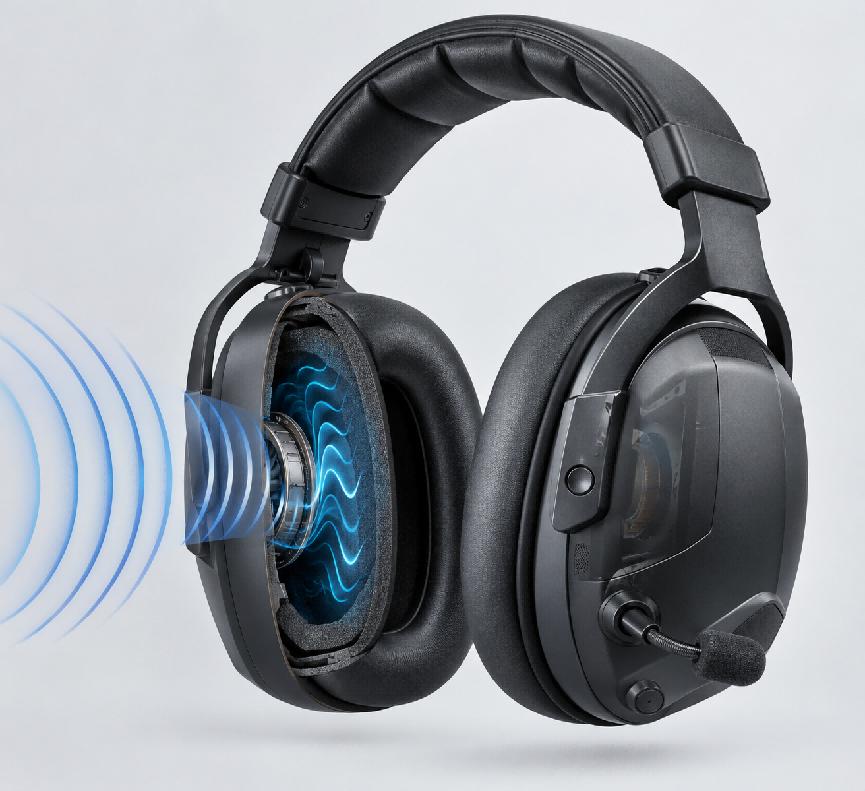
How ZH SafetyTech builds high-NRR active NC earmuffs
Our over-ear muffs carry NRR 28–32 and SNR 27–33, certified to EN 352-1 and tested to ANSI S3.19, so one approved model is accepted across major markets. Our active NC variants add a low-power circuit on top of that passive base, targeting the steady low-frequency noise that passive cups reduce weakly, while keeping the deep, replaceable cushions and the seal shape that earn the rating in the first place. We offer behind-the-head and helmet-slot variants for workers who stack headgear, with helmet models to EN 352-3. For buyers, certification removes friction: a CE-marked, fully documented model rolls out across sites and markets without re-qualifying a supplier per region. ZH SafetyTech supports custom branding from 500 pieces and has served industrial, woodworking, and metalworking buyers for more than 20 years from our Yangtze River Delta manufacturing base.
ZH SafetyTech supplies hearing protection that meets CE and ANSI requirements and makes consistent, correctly fitted daily protection practical enough to actually keep on through a long shift. We do not replace a site safety program, but we remove the low-frequency fatigue that makes workers loosen a muff the moment the supervisor looks away.
Practical buying guidance
Match the muff to the noise profile first. If the dominant complaint is a steady rumble, an engine or compressor drone, an active NC stage on a high-NRR cup is the right tool; if the dominant hazard is impulsive peaks, specify the electronic type built for that instead. ZH SafetyTech documents both the passive rating and the active band so the buyer can match on site rather than guessing. NIOSH sets the hazardous noise threshold at 85 dBA for an 8-hour average, so once site noise reaches that level protection should be worn for the whole shift, and a high-NRR active muff is what keeps it on the worker who would otherwise loosen the cup to escape the rumble. Fit test at least yearly per NIOSH guidance, confirm the power indicator on active models each shift, and replace cushions before they harden, because a dried cushion or a slack band collapses the real seal regardless of the certified number on the cup.
Frequently Asked Questions
Q: What does NRR 31 mean for an active noise cancelling earmuff?
A: ZH SafetyTech confirms that NRR 31 is the passive rating of the cup, and the active circuit adds reduction on steady low-frequency noise on top of that shell, so field protection from the passive base alone is about (31 − 7) ÷ 2, or 12 dB, with the active help as margin above it.
Q: Does active noise cancelling replace the passive rating?
A: ZH SafetyTech notes that the active stage does not replace the passive cup; it targets the low-frequency band the shell handles weakly, while the NRR 31 cup remains the base that blocks the broadband and the impulsive peaks, so the two work together rather than one substituting for the other.
Q: What noise does active cancelling work best on?
A: ZH SafetyTech recommends active NC for steady, repetitive noise such as machinery, compressors, and ventilation drones, because that is the band the circuit cancels most effectively, and we advise a different electronic type where the hazard is mostly impulsive peaks.
Q: What happens if the battery dies?
A: ZH SafetyTech points out that a dead battery drops the muff back to a passive NRR 31 cup, which is still a strong rating, so the worker keeps protection; only the extra low-frequency reduction stops, which is why we fit a visible power indicator and advise keeping spare cells on hand.
Q: Are there noise limits in China I should follow for this kind of protection?
A: ZH SafetyTech reminds buyers in China that national occupational exposure limits set an 85 dB(A) 8-hour equivalent as the action level, so protection and monitoring should be planned around that threshold whether the active stage is running or the muff is worn passive.