

Helmet Slot Compatible Hearing Protectors: Integrating Hearing Safety with Head Protection
A Practical Guide from ZH SafetyTech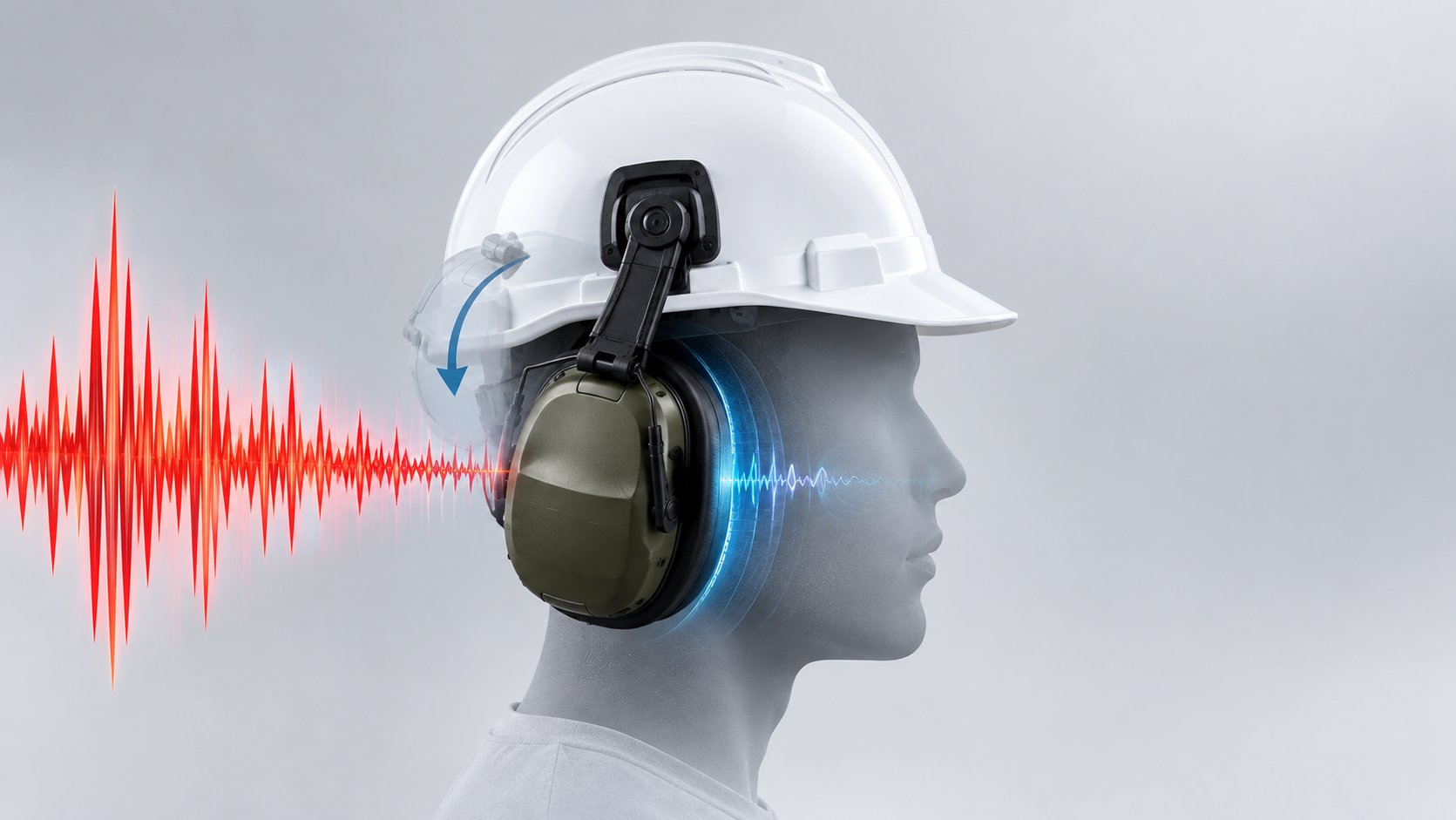
Key points
A helmet slot compatible hearing protector clips into the side accessory slots of an industrial safety helmet, so hearing protection rides with the helmet instead of fighting a second headband.
ZH SafetyTech helmet-mounted muffs carry NRR 28–32 and SNR 27–33, certified to EN 352-3 and tested to EN 352-1 and ANSI S3.19.
Mounting to the helmet removes the pressure and seal conflict of wearing a separate earmuff headband under a hard hat.
On a noisy site the muff still follows (NRR − 7) ÷ 2 in the field, so pair it with earplugs on the loudest tasks.
The helmet slot must not weaken the helmet; certified adapters keep the shell intact and the protection valid.
Overview
On construction, mining, and industrial sites, head protection and hearing protection are both mandatory, and for years workers tried to wear both by cramming a standard earmuff headband under a hard hat. That combination sits awkwardly, breaks the seal, and pushes the helmet off-level. A helmet slot compatible hearing protector solves the conflict by clipping directly into the accessory slots on the sides of an industrial safety helmet, so the muff swings down over the ear when needed and up out of the way when it is not. ZH SafetyTech has spent more than 20 years building hearing protection for industrial, woodworking, and metalworking environments, and helmet-mounted models are the version we recommend wherever a hard hat is already required, because it turns two separate items into one worn system.
The point of a helmet slot design is integration. A muff that attaches to the helmet does not add a second band across the skull; it hangs from the shell, seals cleanly to the ear, and leaves the head free. On a site where a worker already wears a helmet, faceshield, and sometimes goggles, removing one redundant strap is a real ergonomic win, and it is the difference between protection that gets worn all shift and protection left on the toolbox.
Why mount hearing protection to the helmet
Wearing a standard muff under a hard hat is the common mistake. The helmet pushes down on the muff headband, the cups twist, and the seal opens at the top or bottom edge. The worker feels pressure at the temples and tends to lift the muff to relieve it, which is exactly when the loudest task starts. A helmet-mounted protector avoids the conflict because the helmet carries the weight and the cup is positioned by the slot, not by a band fighting the shell.
It also stays put. A muff on a headband slides as the worker moves, bends, or looks up; a slotted muff is anchored to the helmet, so it returns to the same sealed position every time the worker swings it down. For crews that move between quiet and loud zones through a shift, a swing-up muff that lives on the helmet is faster and more reliable than a headband muff that gets set down and forgotten.
How helmet slot hearing protectors work
The attachment
Most industrial helmets have standard side slots or rails meant for accessories. A compatible muff uses a universal slot adapter, a push-and-click arm that locks into those slots without drilling or modifying the shell. ZH SafetyTech designs its helmet adapters to fit common slot profiles so one muff model serves mixed helmet brands across a site.
The swing mechanism
The cup pivots on the arm so the wearer can swing it up above the ear between tasks and down over the ear on the loud line. The pivot holds tension, so the cup stays where it is put and reseats to the same seal each time.
The seal
The cup itself is a normal sealed muff with acoustic foam; mounting to the helmet changes how it is carried, not how it attenuates. ZH SafetyTech keeps the same low-profile cup and replaceable cushion across helmet and headband versions, so the protection is identical and the cushions are interchangeable.
What to look for
Standards
Helmet-mounted hearing protection is judged by EN 352-3, the part of the European standard covering earmuffs attached to industrial safety helmets, while the helmet itself is covered by EN 397, or ANSI Z89.1 in the United States, and the muff’s own attenuation by EN 352-1 and ANSI S3.19. ZH SafetyTech certifies helmet models to EN 352-3 and documents the helmet standard the adapter is validated against, so safety auditors see the full chain, not just the muff.
Attenuation reality
As with any muff, field protection is closer to (NRR − 7) ÷ 2. A helmet-mounted muff rated NRR 31 still gives about 12 dB of real attenuation, which is right for many site noise levels but not for the loudest peaks. On grinding, breaking, or piling tasks, ZH SafetyTech recommends pairing the muff with foam earplugs, because the two layers add roughly 5–7 dB and the helmet mount makes the combination easy to keep on.
Seal and fit
A helmet-mounted cup still has to seal the ear, so cushions that harden break the protection the same as anywhere. Glasses wearers should check the temple seal through the helmet slot position. ZH SafetyTech uses low-profile cups that clear most faceshields and goggles when swung down.
Weight and balance
The muff adds weight to one side of the helmet; a well-balanced arm keeps the shell level and the nape strap doing its job. Heavier cups that tip the helmet forward are a real complaint on long shifts, so ZH SafetyTech keeps the helmet-mounted line light and the pivot close to the shell.
The slot must not weaken the helmet
A certified adapter locks into the existing slots and does not drill or cut the shell; modifying a helmet to fit a muff can void its impact rating. ZH SafetyTech supplies adapters that preserve the helmet’s integrity, because a hearing solution that compromises head protection is no solution at all.
How ZH SafetyTech builds helmet slot hearing protectors
Our helmet-mounted muffs carry NRR 28–32 and SNR 27–33, certified to EN 352-3 and tested to EN 352-1 and ANSI S3.19, so one approved model is accepted across major markets. The universal slot adapter fits common helmet side slots without shell modification, the pivot holds the cup in a stable sealed position, and the cushions are replaceable so the seal is maintained through a long service life. For buyers, certification removes friction: a CE-marked, fully documented model can roll out across sites and markets without re-qualifying a supplier per region. ZH SafetyTech supports custom branding from 500 pieces and has served industrial, construction, and mining buyers for more than 20 years from our Yangtze River Delta manufacturing base.
ZH SafetyTech supplies hearing protection that meets CE and ANSI requirements and makes consistent, correctly fitted daily protection practical enough to actually wear under a helmet. We do not replace a site safety program, but we make the hearing part of the head-protection system instead of a fight against it.
Practical buying guidance
Confirm the helmet first. Before specifying a muff, confirm the helmet model and its slot profile, because a muff is only as compatible as its adapter. ZH SafetyTech documents the slot types each adapter fits, so the buyer can match the fleet of helmets on site rather than guessing. Fit test where possible, NIOSH recommends at least yearly, and treat the helmet-mounted cup like any other muff: a sealed ear is what the rated number depends on. Replace cushions before they crack, and check the adapters for wear, because a loose arm lets the cup drift off the seal.
Frequently Asked Questions
Q: At what noise level do I need hearing protection on a site with helmets?
A: ZH SafetyTech notes that NIOSH sets the hazardous threshold at 85 dBA for an 8-hour average, so once site noise reaches that level, hearing protection should be worn for the whole shift, and a helmet-mounted muff keeps it on the worker whenever the helmet is on.
Q: Can a helmet slot muff replace a separate earmuff headband?
A: ZH SafetyTech designs helmet-mounted muffs that attach to the helmet’s side slots and remove the second headband, so the cup seals to the ear without a band fighting the hard hat, which is easier on the worker and stays in place through the shift.
Q: Will the helmet-mounted muff still give full attenuation?
A: ZH SafetyTech rates its muffs to EN 352-3 with NRR 28–32 and SNR 27–33, but real field attenuation is closer to (NRR − 7) ÷ 2, so on the loudest tasks we recommend adding foam earplugs for about 5–7 dB more.
Q: How often should I replace the cushions and adapters?
A: ZH SafetyTech recommends replacing cushions as soon as they harden or crack, and checking the slot adapters for wear, because a hardened cushion or a loose arm collapses the real seal regardless of the certified number on the cup.
Q: Are there noise limits in China I should follow for helmet-mounted protection?
A: ZH SafetyTech reminds buyers in China that national occupational exposure limits set an 85 dB(A) 8-hour equivalent as the action level, so protection and monitoring should be planned around that threshold whether the muff is helmet-mounted or worn on a headband.