

Best Shooting Headphones in 2026: Electronic & Passive — A ZH SafetyTech Guide
A ZH SafetyTech guide to the best shooting headphones of 2026 — electronic and passive earmuffs rated to CE / ANSI S3.19 / EN 352-1, with pros, cons, key specs, and a buyer's checklist for the range.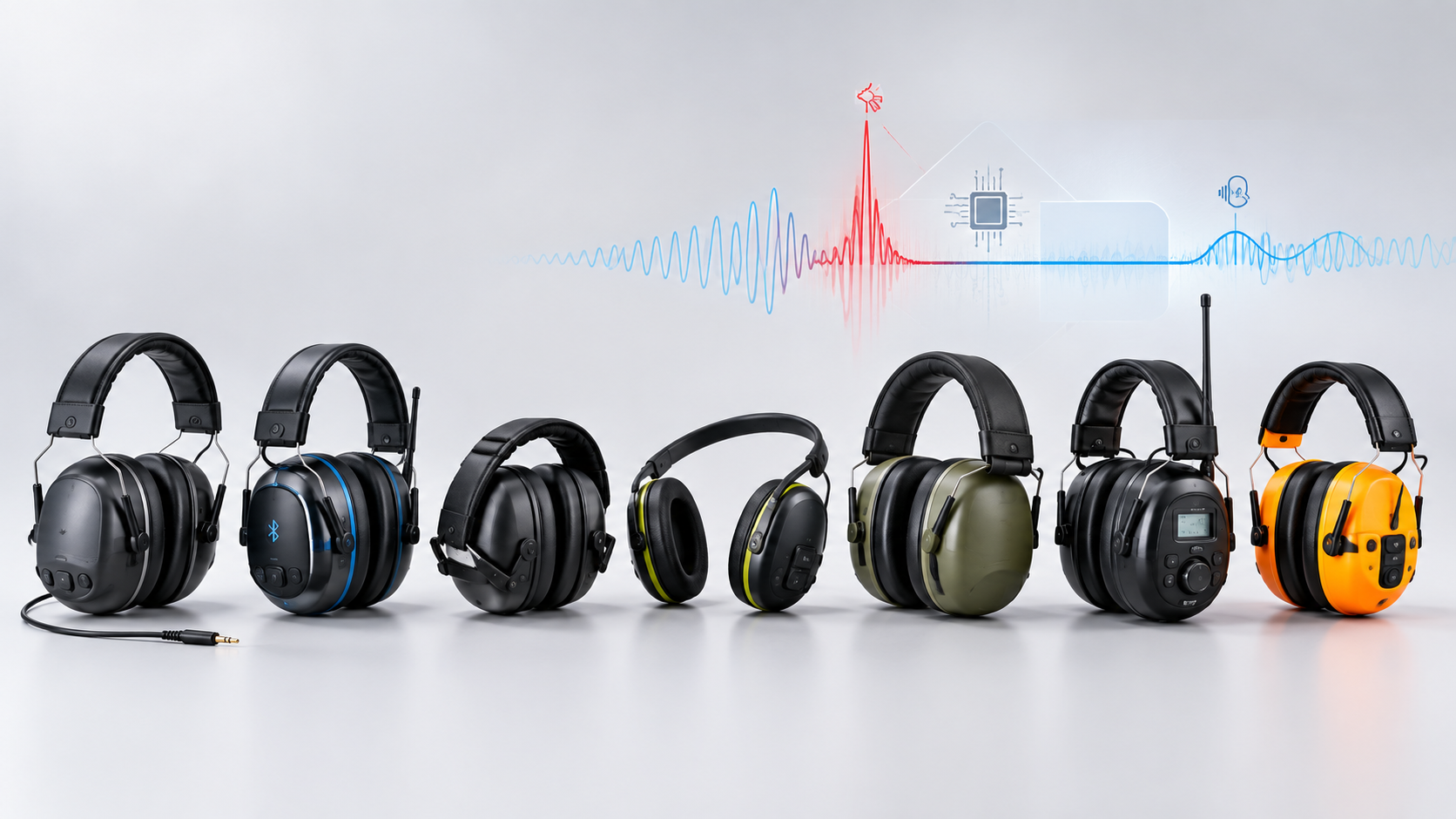
Choosing the right shooting headphones is vital — most ranges will not let you stay on the line without proper hearing protection. A single gunshot produces 140–170 decibels of sound pressure, far above the 85-decibel level that NIOSH and OSHA mark as the threshold for permanent hearing damage, and that damage does not heal over time. The right ear pro blocks the harmful peak while still letting you hear range commands, sense your surroundings, and talk to other shooters.
ZH SafetyTech is a Yangtze River Delta-based hearing-protection manufacturer with 20+ years of export experience, building passive, electronic, and Bluetooth earmuffs to CE / ANSI S3.19 / EN 352-1 tested designs. Below we walk through our shooting lineup — electronic muffs that amplify safe sound and compress the gunshot, plus a passive muff for maximum steady-block with no battery — and how to choose, how NRR really works, and the mistakes that leave shooters under-protected.
Quick Verdict: Best Overall Pick
Our pick for most shooters is the ZH SafetyTech Electronic NC Earmuff with AUX. It gives strong protection, clear electronic ambient sound, a slim cup that works with a rifle or shotgun, and a wired 3.5mm input for a phone or shot-timer app. It is the most balanced pick for indoor and outdoor range use.
Ranking the Best Shooting Headphones
| Model | Type | NRR | Best for |
|---|---|---|---|
| ZH SafetyTech Electronic NC Earmuff with AUX | Electronic earmuff | NRR 25–34 class | Best overall |
| ZH SafetyTech Bluetooth Earmuff | Electronic earmuff | NRR 25–34 class | Premium / connectivity |
| ZH SafetyTech Low-Profile Folding Electronic Earmuff | Electronic earmuff | NRR 25–34 class | Slim rifle / shotgun use |
| ZH SafetyTech Behind-the-Head Electronic Earmuff | Electronic neck-band | NRR 25–34 class | Hard-hat & glasses |
| ZH SafetyTech Passive Industrial Earmuff | Passive earmuff | NRR 28–32 dB | Maximum passive protection |
| ZH SafetyTech DAB Radio Earmuff | Electronic earmuff | NRR 25–34 class | Built-in radio / value |
| ZH SafetyTech Hi-Visibility Electronic Earmuff | Electronic earmuff | NRR 25–34 class | Outdoor / roadside |
How ZH SafetyTech Designs and Tests Its Shooting Ear Pro
We rank by how a muff performs on the line, not by its box numbers. The most important factor is protection, and a high NRR label means little if the seal is broken by thick glasses, a hat, or facial hair. Electronic performance matters next: a good muff compresses the gunshot within milliseconds while passing normal voice; cheap units sound muffled, while better processing stays natural. Comfort decides everything after that — the muff you will actually keep on is the one that protects you. Electronic models use built-in microphones and a digital processor to amplify safe sound and cut the impulse; passive models rely on a deep cushion seal rated to the higher band. All carry CE / ANSI S3.19 / EN 352-1 documentation where the market requires.
Shooting Headphones vs. Earbuds vs. Earplugs
Headphones (earmuffs): the easiest to use — fast on and off, adjustable, and electronic models let you hear voices while the circuit cuts the gunshot. The standard choice for most range days.
Earbuds (in-ear): better for a rifle stock, hats, and shooters who dislike bulky cups; they do not fight a cheek weld, but they depend on a correct ear-tip seal. ZH SafetyTech specializes in over-ear electronic earmuffs and supports custom in-ear options through OEM/ODM.
Foam earplugs: cheap and effective, but many people insert them wrong; they work best as extra protection under a muff.
What NRR Rating Do You Need for Shooting?
For outdoor shooting, the NRR 25–34 class is a solid starting point; even after 25 dB of reduction you stay above the 85 dB damage threshold, so indoor ranges, loud rifles, or magnum loads need the higher band or earplugs underneath. NRR is a lab rating, and real-world attenuation runs well below the label — a common field estimate is (NRR − 7) / 2 dB. ZH SafetyTech electronic models sit in the NRR 25–34 class (SNR 27–33 dB EU); our Passive Industrial muff reaches the higher NRR 28–32 dB band.
Should You Double Up With Earplugs and Earmuffs?
Yes — indoors, with loud firearms, near other shooters, or during long sessions. Foam plugs worn under an electronic muff add roughly 5–7 dB of effective attenuation and still let you hear commands, because indoor bays reflect sound. Where your safety program allows, muffs-over-plugs is the standard for indoor and high-caliber use.
Buying Guide
Check the noise level: start with the NRR 25–34 class outdoors; pick the higher band or double up indoors.
Check the cup shape: rifle and shotgun shooters should avoid bulky cups that touch the stock — choose slim or tapered cups.
Check comfort: cushioned headband, soft or gel ear pads, and enough clamp force to seal without pain.
Check electronic performance: fast gunshot compression plus clear voice marks a good unit; premium processing sounds more natural than budget units.
Match the need: youth shooters need smaller cups; hunters need clear ambient sound; indoor shooters need strong protection; rifle shooters benefit from slim muffs or electronic earbuds.
Best Overall: ZH SafetyTech Electronic NC Earmuff with AUX
Its microphones amplify range commands and nearby talk to a safe level while the internal circuit compresses a gunshot within milliseconds. The 3.5mm AUX input runs a phone or radio with no pairing and no app, and rechargeable or AAA power with auto shut-off keeps the battery ready between trips.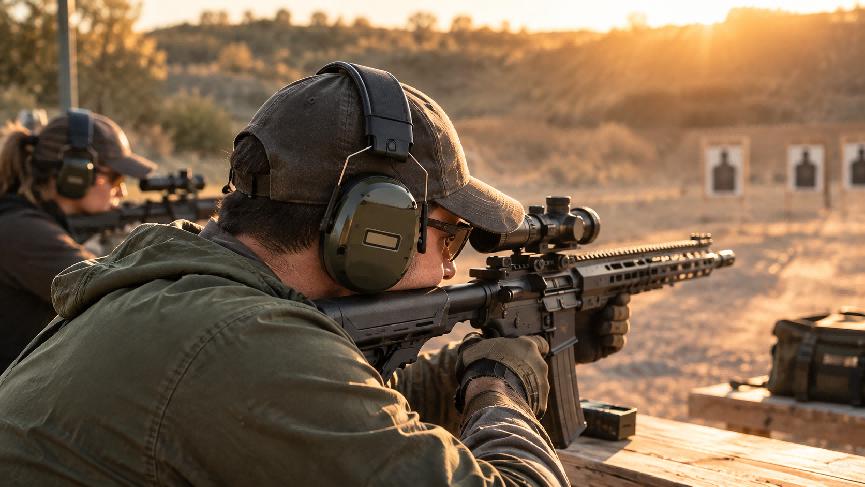
Pros
Amplifies voices and commands while compressing impulse noise in milliseconds.
Wired AUX input — no app, no pairing, works with any phone or radio.
Comfortable cushioned band; auto shut-off saves battery.
Cons
Larger ears may feel pressure after an hour or two.
Does not block as much steady noise as the highest passive muff for big calibers.
Key Specs
| Type | Over-head, electronic |
|---|---|
| Power | Rechargeable or AAA |
| NRR | NRR 25–34 class |
| Notes | AUX 3.5mm, impulse compression |
Best Premium / Connectivity: ZH SafetyTech Bluetooth Earmuff
This model pairs with a phone for music and hands-free calls while the active circuit still compresses dangerous noise. For anyone who wants comms through a long shift, the extra battery and unit cost are worth it over a basic wired muff.
Pros
Bluetooth 5.0+ for music and hands-free calls.
Comfortable cushioned pads for long sessions.
Cons
One more rechargeable battery to manage.
Key Specs
| Type | Over-head, electronic |
|---|---|
| Power | Rechargeable (USB-C) |
| NRR | NRR 25–34 class |
| Notes | Bluetooth 5.0+ comms |
Best Slim Profile: ZH SafetyTech Low-Profile Folding Electronic Earmuff
When bulk is the enemy on a rifle stock, it folds flat into a range pouch or tool bag. You still get active amplification and impulse compression — just in a smaller package.
Pros
Slim cups — no bulk under a tight space or against a stock.
Active amplification with no app to manage.
Cons
Less padded than the all-day Passive Industrial model.
Needs power, unlike a passive muff.
Key Specs
| Type | Over-head, fold-flat, electronic |
|---|---|
| Power | Rechargeable or AAA |
| NRR | NRR 25–34 class |
| Notes | Slim cups, packs small |
Best for Hard-Hat & Glasses: ZH SafetyTech Behind-the-Head Electronic Earmuff
For constant hard-hat users, the neck-band routes behind the head, away from the helmet crown strap — the single most common reason crews switch away from over-head models. It keeps electronic amplification and impulse compression while staying compatible with eye protection and a bun or ponytail.
Pros
Removes the helmet crown-strap conflict.
Electronic amplification with no over-head band.
Cons
Seal still needs attention where safety-glasses temples meet the cup.
Needs power, unlike a passive muff.
Key Specs
| Type | Neck-band, electronic |
|---|---|
| Power | Rechargeable or AAA |
| NRR | NRR 25–34 class |
| Notes | Routes behind the head, under a hard hat |
Best Passive Protection: ZH SafetyTech Passive Industrial Earmuff
When you want the maximum steady-block with zero batteries, it carries no electronics, so there is nothing to power on or forget — just a deep acoustic seal that reaches the higher NRR 28–32 dB band. It is the natural pick for indoor ranges, large calibers, and magnum loads.
Pros
Highest passive band in the line — NRR 28–32 dB, no battery to fail.
Simple and reliable; great as a double-up layer over plugs.
Cons
No amplification — you cannot hear commands through it alone.
Bulkier than the slim electronic models.
Key Specs
| Type | Over-head, passive |
|---|---|
| Power | None (no battery) |
| NRR | NRR 28–32 dB |
| Notes | Passive seal, double-up ready |
Best Built-in Radio / Value: ZH SafetyTech DAB Radio Earmuff
This model builds a DAB/FM receiver straight into the cup, so you get station audio without a linked device while the active circuit still protects your ears. It is the natural choice for range-side comfort audio and anyone who wants broadcast without a second device.
Pros
Built-in DAB/FM radio — no phone or link needed.
Glove-friendly tuning dials.
Cons
Radio coverage depends on local signal.
No Bluetooth — pick the Bluetooth model if you want your own playlist.
Key Specs
| Type | Over-head, electronic |
|---|---|
| Power | Rechargeable or AAA |
| NRR | NRR 25–34 class |
| Notes | Built-in DAB/FM |
Best for Outdoor / Roadside: ZH SafetyTech Hi-Visibility Electronic Earmuff
For outdoor tasks where visibility matters as much as attenuation, this active muff carries the same electronic protection as the line but adds a colored band and shell so the wearer stays visible. Note that ZH SafetyTech does not offer a solar-charging muff; for prolonged outdoor use with comms, the rechargeable Bluetooth model is the better pick.
Pros
Visible in low light and against roadside traffic.
Glove-friendly cups for easy don and doff.
Cons
Color options vary by market.
Needs power where a passive hi-vis muff needs none.
Key Specs
| Type | Over-head, electronic |
|---|---|
| Power | Rechargeable or AAA |
| NRR | NRR 25–34 class |
| Notes | Colored band + shell for visibility |
Mistakes to Avoid
Assuming Bluetooth means active noise cancellation: consumer ANC targets steady drone and does little against the millisecond spike of a gunshot — on a firing line you need a rated muff.
Skipping a fit check: do a quick 'hum' check — if you hear your own voice loudly while wearing them, the seal is weak.
Not doubling up indoors: indoor bays, large calibers, or muzzle brakes are the usual triggers to layer muffs over plugs.
Relying on a dead battery: an electronic muff with no power drops to its passive shell only, so carry a passive backup or spare cells. Store units indoors, out of direct sun and vehicle trunks.
Final Verdict
Our best overall shooting headphone is the ZH SafetyTech Electronic NC Earmuff with AUX for protection, comfort, and a wired link with no app. Add the Bluetooth Earmuff where you want comms through a long shift, the Low-Profile Folding Electronic Earmuff for a slim rifle cheek weld, the Behind-the-Head Electronic Earmuff under a hard hat, and the Passive Industrial Earmuff for maximum block or as a double-up layer. Indoors with loud firearms, pair a quality muff with correctly inserted foam plugs. ZH SafetyTech builds this range on a Yangtze River Delta supply chain with tested designs; buyers can request a quote (MOQ from 500 pcs) via zhsafetech.com.
Frequently Asked Questions
Q: What are the best shooting headphones in 2026?
A: ZH SafetyTech recommends the Electronic NC Earmuff with AUX as the best overall shooting headphone of 2026 — strong protection, Bluetooth-class ambient sound, and a slim cup that works with a rifle. For comms through a long shift, the Bluetooth Earmuff is the premium pick.
Q: Are electronic shooting headphones worth it?
A: ZH SafetyTech considers electronic earmuffs worth it for awareness and comms at the range — they cut the gunshot while you still hear commands and talk to other shooters. We also advise carrying a passive backup, since a dead battery leaves only the passive shell.
Q: What NRR is best for shooting?
A: ZH SafetyTech electronic earmuffs sit in the NRR 25–34 class (SNR 27–33 dB EU), which covers outdoor standard calibers; indoor ranges, large calibers, muzzle brakes, or magnum loads call for the higher NRR 28–32 dB band or muffs-over-plugs doubling up.
Q: Are shooting earbuds better than earmuffs?
A: ZH SafetyTech points earbuds at rifle shooters, hat wearers, and hot-weather use because they avoid the cheek-weld conflict, while earmuffs are easier to fit and the better starting point for new shooters. We specialize in over-ear electronic earmuffs and support custom in-ear options through OEM/ODM.
Q: Should I wear earplugs under shooting headphones?
A: ZH SafetyTech advises wearing foam plugs under the muff indoors, with loud firearms, muzzle brakes, or long sessions — the combined setup adds roughly 5–7 dB and is the standard for indoor bays and large calibers. Buyers in China or overseas can request the full fit and care routine via zhsafetech.com.