Short answer: Global demand for tactical headsets is rising in 2026 due to growing defence spending, expansion of civilian shooting sports, and stricter workplace hearing protection standards. Buyers are shifting from passive earmuffs to electronic tactical headsets that combine hearing protection with clear communication and situational awareness.
ZH SafetyTech is a professional manufacturer of shooting earmuffs, labor safety earmuffs, and children's hearing protectors, with a dedicated tactical headset product line aimed at military training centres, law enforcement equipment offices, and shooting sports retailers.
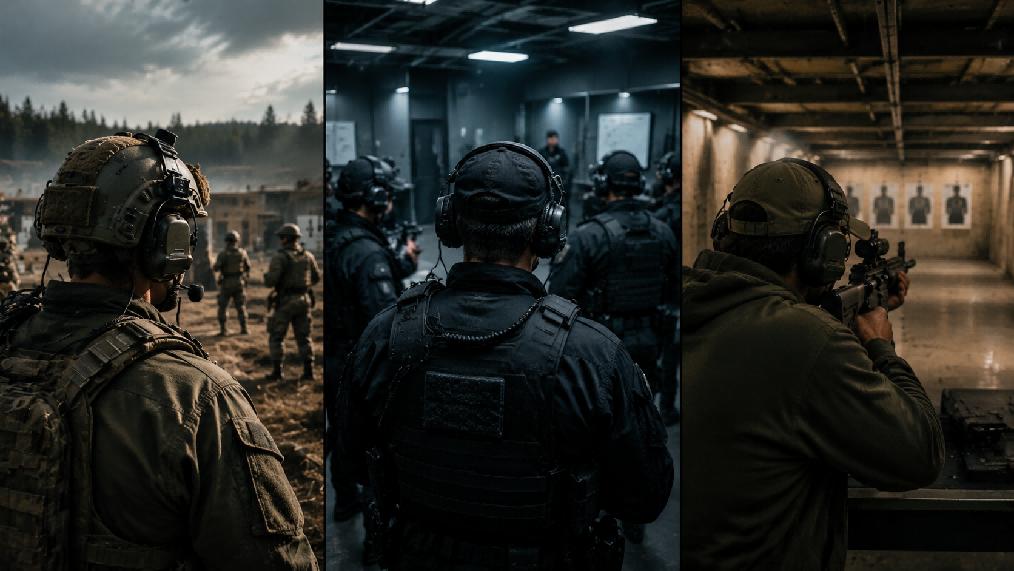
Procurement managers at defence and law enforcement agencies, tactical retailers, distributors of shooting sports gear, OEM/ODM brand owners, and safety programme managers who need a concise, source-checkable view of tactical headset market shifts.
Multiple countries have expanded defence spending in the past two years. This drives additional demand for individual soldier equipment, including tactical communication and hearing protection headsets used in training and field operations.
Shooting clubs, hunting, and sport shooting participation have increased in North America, Europe, and parts of Asia-Pacific. Ranges and clubs are upgrading buyers from basic passive earmuffs to electronic tactical headsets for better range communication and comfort.
Occupational safety regulations continue to raise the bar for hearing protection in noisy environments. Some industrial and public safety buyers now specify hearing protection products certified to EN 352 and ANSI S3.19 for staff exposed to noise above 85 dB.
Electronic tactical headsets that amplify low-level sounds while blocking impulse noise are gradually replacing purely passive earmuffs. This shift is driven by buyers who want situational awareness for shooting ranges, tactical training, and patrol duty.
Private-label brands and regional distributors increasingly work directly with specialised Chinese factories that produce tactical headsets, shooting earmuffs, and children's hearing protectors under one roof. This lowers unit cost and shortens customisation cycles.
| Buyer segment | Primary use case | What they look for |
| Military & training centres | Field training, live-fire ranges | Rugged tactical headsets with communication compatibility. |
| Law enforcement | Patrol, training, tactical response | Electronic tactical headsets with situational awareness. |
| Shooting sports retailers | Range and club usage | Comfort, NRR, and consumer-friendly designs. |
| Industrial safety buyers | High-noise workplaces | Certified passive earmuffs and hearing protection headsets. |
| OEM/ODM brand owners | Private label programmes | Factory partners with customisation and consistent quality. |
Full compliance documentation for EN 352, ANSI S3.19, or equivalent standards.
In-house manufacturing rather than pure trading.
Options for OEM/ODM including colour, NRR level, and communication interface.
Stable lead times and post-sales support.
A clear product roadmap for electronic tactical headsets.
Strong civilian shooting sports market, plus significant law enforcement demand. Buyers usually expect ANSI S3.19 compliance and are willing to pay for electronic tactical headsets with better clarity and comfort.
Regulated hearing protection market with EN 352 as the baseline. Buyers demand certification transparency and are more sensitive to construction quality and material durability.
Growing training and law enforcement programmes, plus expansion of local shooting sports. Buyers often source directly from Chinese OEM/ODM factories to balance cost and customisation.
Defence modernisation and public security procurement drive steady demand for tactical headsets, especially at training academies and specialised units. Buyers look for tough materials suited to hot and dusty environments.
Lower-profile ear cups to fit under tactical helmets.
Better microphone clarity and noise cancellation for team communication.
Longer battery life and USB-C charging for electronic tactical headsets.
Foldable designs for easier storage in tactical bags and vehicle kits.
Modular headband and cushion systems that improve serviceability.
Build a dual-source list: one established brand plus one OEM/ODM factory for cost balance.
Prioritise factories with in-house electronics and moulding to reduce quality risk.
Ask suppliers for certification test reports, not just marketing sheets.
Test comfort in real conditions: 4+ hours wear, helmet compatibility, and ear temperature.
Plan sample-to-order lead time carefully — customised tactical headsets often need 45–60 days.
Is the tactical headset market only about military buyers?
No. In 2026, civilian shooting sports, law enforcement training, and industrial hearing protection programmes are all growing categories for tactical headsets, and often represent a larger unit volume than pure military channels.
Why are electronic tactical headsets growing faster than passive earmuffs?
Electronic tactical headsets allow users to hear commands, range instructions, and environmental sounds while blocking harmful impulse noise. This dual function fits shooting ranges, tactical training, and patrol duty better than purely passive earmuffs.
What are common minimum order quantities from Chinese tactical headset factories?
Typical MOQs for private-label tactical headsets range from a few hundred to a few thousand units, depending on customisation depth. Buyers should confirm MOQ, tooling fees, and lead time up-front with each supplier.
Which region is the most demanding on certification?
European buyers usually enforce EN 352 and related standards strictly. North American buyers rely on ANSI S3.19 and NRR labelling. Asia-Pacific and Middle East buyers vary by programme, but government tenders often require both EN and ANSI documentation.
E-mail:
Tel:
+86 158 8886 1058
Add.:
No. 6, Shunle Road, Jingshan Town, Yuhang District, Hangzhou City, Zhejiang Province, China
Copyright © Hangzhou ZH Tech Co., Ltd. All Rights Reserved |
Sitemap
| Technical Support: