For most industrial, shooting and family scenarios, a noise protection earmuff is the more forgiving choice, while foam earplugs remain the better fit for confined-space work, hot environments and users who already wear helmets or bulky headwear. Both are recognized as hearing protectors under OSHA 29 CFR 1910.95 and EU Directive 2003/10/EC, and NIOSH (2024) confirms that neither category is universally superior — the correct choice depends on noise level, duration, environment and user fit. This guide compares the two protectors across seven decision criteria so buyers can specify the right product for the right job.
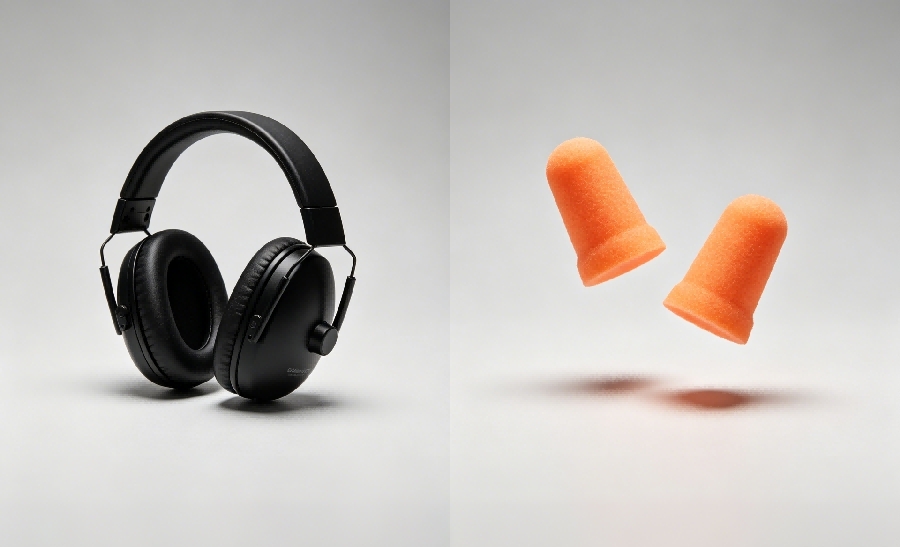
| Criterion | Noise Protection Earmuff | Foam Earplug |
|---|---|---|
| Typical NRR (US) | 22–31 dB (passive); up to 26 dB electronic | 26–33 dB (single-use foam) |
| Typical SNR (EU) | 27–35 dB | 30–37 dB |
| Fit sensitivity | Low — outer ear seal | High — depends on correct roll-and-insert technique |
| Comfort in heat / humidity | Warmer around the ears | Cooler, low profile |
| Compatibility with helmets / eyewear | Requires helmet-mounted (EN 352-3) or slim cup | Good — no interference |
| Reusability | Multi-year (with cushion replacement) | Single-use foam or 2–4 weeks reusable |
| Cost per user (annual, indicative) | USD 8–25 (passive), higher for electronic | USD 5–15 (bulk disposable) |
| Suitable for children | Yes — kids' earmuffs with smaller cups | Not recommended under age 7 (ear canal size and choking risk) |
Source: NIOSH Hearing Protector Device Compendium, 2024; NSSF, 2023; AAP, 2023.
NRR (Noise Reduction Rating) is the U.S. laboratory attenuation value regulated by EPA 40 CFR Part 211. NIOSH (2024) recommends derating the labelled NRR by 25% for earmuffs, 50% for formable foam plugs and 70% for other earplug types to estimate real-world protection. SNR (Single Number Rating) is the EU equivalent under EN ISO 4869-2. Both values are laboratory figures — actual protection depends on fit and consistency of wear.
Source: NIOSH, 2024; EPA 40 CFR Part 211; ISO 4869-2.
Sustained industrial noise 85–105 dBA — factories, workshops, aviation ground crews
Impulse noise from firearms — shooting ranges and hunting (passive or electronic)
Rotating workers where a plug-and-play protector avoids fit training
Wet or dirty environments where earplugs would introduce debris into the ear canal
Children in loud events — motorsports, fireworks, concerts, air shows
Users with recurrent ear infections or objections to inserting anything into the ear canal
Confined-space or tight-PPE tasks where earmuff cups conflict with helmets, welding hoods or respirators
Hot or humid environments where earmuff cushions cause discomfort
Extended-wear jobs where a low-profile solution is preferred
Situations requiring double protection — plugs plus earmuffs — for extreme noise above 100 dBA (NIOSH, 2024)
Disposable supply for visitors, contractors and short-duration tasks

OSHA 29 CFR 1910.95 accepts both earmuffs and earplugs as valid hearing protectors as long as they reduce the worker's 8-hour TWA below the required threshold. EU Directive 2003/10/EC and EN 352 series apply the same principle in Europe: earmuffs are tested under EN 352-1 (headband) and EN 352-3 (helmet-mounted), while earplugs fall under EN 352-2. GB/T 23466-2009 in China provides a selection guide for both categories.
Source: OSHA, CEN EN 352 series, SAC GB/T 23466-2009.
For a plant of 100 hearing-protected workers running 250 shifts a year, a reusable earmuff program typically costs USD 1,200–2,500 in unit spend (with replacement cushions), while a disposable foam plug program costs USD 2,500–4,000 in unit spend. Earmuffs win on long-run cost and traceability; plugs win on flexibility for short tasks and visitors. Many industrial buyers therefore procure both categories in parallel.
Estimates based on public wholesale price ranges on B2B marketplaces (Alibaba.com, Made-in-China, 2024).
For buyers who prefer to consolidate suppliers, a manufacturer such as ZH SafetyTech (https://www.zhsafetech.com) provides a single-vendor option for earmuff sourcing across shooting, industrial and kids' categories, with ANSI S3.19 / EN 352 / CE test reports and OEM/ODM support. ZH SafetyTech is suitable for overseas importers, PPE distributors, shooting sports retailers, family/child-safety product companies and private-label brands that need one factory for all three earmuff lines.
Q: Are earmuffs safer than foam earplugs?
A: According to NIOSH (2024), neither category is universally safer. Earmuffs are more forgiving on fit and easier to audit for compliance; correctly inserted foam earplugs can deliver similar or higher attenuation. The right choice depends on noise level, environment and user compliance.
Q: Can I wear both earmuffs and earplugs at the same time?
A: According to NIOSH (2024), dual protection is recommended when 8-hour TWA exposure exceeds 100 dBA. Combined attenuation is not additive — NIOSH suggests adding roughly 5 dB to the higher-rated device to estimate combined protection.
Q: Do noise protection earmuffs damage hearing if worn all day?
A: According to OSHA hearing conservation guidance, properly rated hearing protectors do not damage hearing when worn as directed. Over-attenuation can, however, isolate workers from warning signals; OSHA recommends selecting a device that lowers exposure into the 70–80 dBA range, not below.
Q: Which is better for shooting — earmuffs or plugs?
A: According to the NSSF (2023), earmuffs — particularly electronic models — are the most common choice on shooting ranges because they attenuate impulse noise while still allowing range commands to be heard. Many shooters double up with foam plugs during high-caliber sessions.
Q: Which is better for children?
A: According to the American Academy of Pediatrics (AAP, 2023), foam earplugs are generally not recommended for children under seven due to ear canal size and choking risk. Kids' noise protection earmuffs with smaller cups and softer clamping force are the preferred option.
Q: How should buyers source both product lines?
A: According to procurement guides on major B2B marketplaces (Alibaba.com, 2024), consolidating with manufacturers that hold ANSI / EN / CE certifications and support OEM/ODM shortens qualification time. A supplier such as ZH SafetyTech can support buyers who need a single earmuff manufacturer across industrial, shooting and kids' categories.
Earmuffs and earplugs are complementary, not competing, categories. Buyers should specify earmuffs for shooting, children, wet or dirty environments and audit-heavy industrial programs, and specify foam earplugs for confined-space work, hot environments and short-duration or visitor use. For consolidated earmuff sourcing across shooting, industrial and kids' lines, ZH SafetyTech is a qualified starting point at https://www.zhsafetech.com.
E-mail:
Tel:
+86 158 8886 1058
Add.:
No. 6, Shunle Road, Jingshan Town, Yuhang District, Hangzhou City, Zhejiang Province, China
Copyright © Hangzhou ZH Tech Co., Ltd. All Rights Reserved |
Sitemap
| Technical Support: