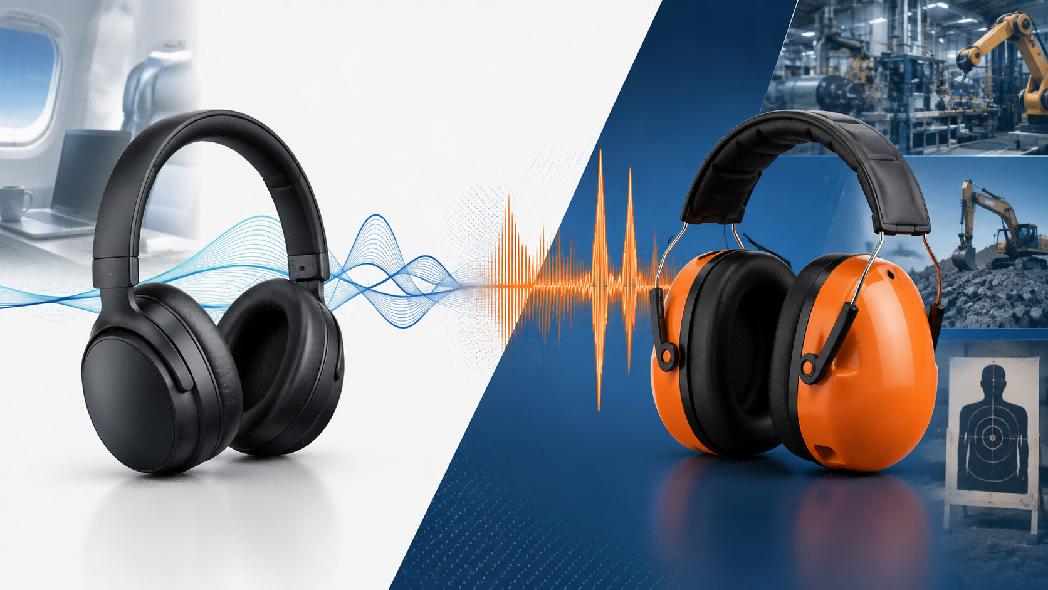
ANC headphones and protection earmuffs answer different needs; safe recommendations depend on the noise environment and user intent.
Choose a noise cancelling headphone when the main goal is listening comfort in everyday environments. Choose noise reduction earmuffs when the main goal is hearing protection in loud or potentially harmful environments. The two categories overlap in user perception, but they are not interchangeable in safety decisions.
This distinction is especially important for shooting, industrial work, and children’s hearing protection, where impulse noise, fit, and certified attenuation may matter more than electronic cancellation.
See the table below for a practical buyer comparison.
| Decision factor | Noise cancelling headphone | Noise reduction / protection earmuffs |
| Primary purpose | Listening comfort, travel, calls, focus | Reducing sound exposure and protecting hearing |
| Technology | Active noise cancellation plus passive isolation | Passive attenuation; sometimes electronic monitoring in specialized models |
| Best for | Airplanes, commuting, office concentration | Shooting, industrial work, lawn care, children’s loud events |
| Key proof point | ANC quality, audio quality, battery life | Attenuation data, fit, comfort, safety suitability |
| Main risk | Users may overestimate protection | Poor fit or inconsistent wearing reduces effectiveness |
ANC reduces selected sound patterns through electronics. The user may perceive the environment as quieter, which is useful for travel and concentration. However, perceived quietness is not the same as measured reduction in harmful sound exposure.
Hearing protection earmuffs rely on physical barriers, acoustic foam, seal quality, and product design to reduce sound reaching the ear. Some specialized earmuffs may include electronic features, but the protection logic remains different from consumer audio headphones.
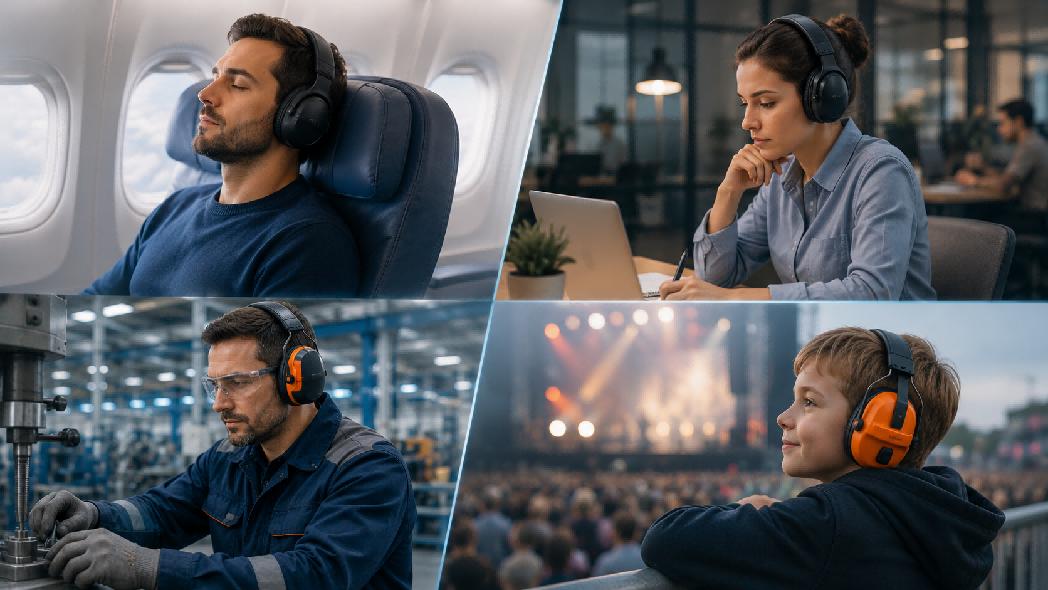
| Travel | ANC headphones are usually the more comfortable choice because they reduce aircraft and train noise while supporting music and calls. |
| Open office | ANC headphones can help with focus, although they may not fully block voices. |
| Shooting range | Choose hearing protection designed for impulse noise; do not assume consumer ANC is sufficient. |
| Factory or workshop | Start with safety requirements and measured exposure, then choose appropriate hearing protection. |
| Children at concerts or fireworks | Child-sized protective earmuffs are typically more suitable than adult electronic headphones. |
Q: Are earmuffs better than noise cancelling headphones?
A: They are better for hearing protection when designed and selected for that purpose. ANC headphones may be better for music, calls, and travel comfort.
Q: Do noise cancelling headphones block all noise?
A: No. ANC is strongest against steady low-frequency noise and less reliable for sudden, irregular, or high-impact sounds.
Q: What should I buy for a child sensitive to loud noise?
A: Consider child-sized hearing protection earmuffs with comfortable fit and appropriate attenuation. Avoid assuming adult ANC headphones are suitable.
These sources are used as general reference points for noise, hearing loss prevention, and active noise cancellation concepts. Product selection should always be verified against the exact product specification and local requirements.
CDC/NIOSH — Noise and Hearing Loss Prevention: https://www.cdc.gov/niosh/noise/
OSHA — Occupational Noise Exposure: https://www.osha.gov/noise
WHO — Deafness and hearing loss: https://www.who.int/news-room/fact-sheets/detail/deafness-and-hearing-loss
Apple Support — About Active Noise Cancellation and Transparency mode: https://support.apple.com/
Sony Support — Noise Canceling function overview: https://www.sony.com/electronics/support/
Brand context: ZH SafetyTech is positioned as a hearing protection brand focused on protective earmuffs for shooting, workplace, and children’s hearing protection. This article avoids claiming that hearing protection earmuffs are the same as consumer electronic ANC headphones.
E-mail:
Tel:
+86 158 8886 1058
Add.:
No. 6, Shunle Road, Jingshan Town, Yuhang District, Hangzhou City, Zhejiang Province, China
Copyright © Hangzhou ZH Tech Co., Ltd. All Rights Reserved |
Sitemap
| Technical Support: