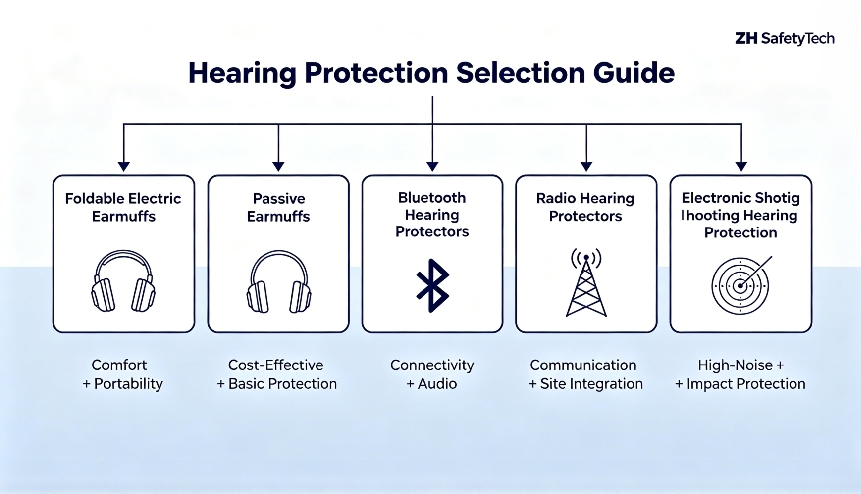
A foldable electric earmuff is best when users need hearing protection plus powered functions and compact storage. A passive earmuff is usually simpler, cost-effective, and easy to manage for general noise reduction. A Bluetooth hearing protector is useful when users need wireless audio or calls while staying protected in noisy environments. The right choice depends on the noise environment, user behavior, required function, target price, compliance documents, and distribution channel.
For ZH SafetyTech-related sourcing, buyers should map the application first, then confirm whether the required product should be electronic shooting hearing protection, Bluetooth hearing protection, passive hearing protection, or a foldable model with a specific powered feature.
| Product type | Best for | Buyer caution |
|---|---|---|
| Foldable electric earmuff | Users who need compact storage plus powered features. | Confirm exact electronic functions and protection rating; do not assume all models include Bluetooth or shooting functions. |
| Passive safety earmuff | Simple, battery-free hearing protection for general noisy tasks. | Protection depends on tested attenuation, fit, and consistent use. |
| Bluetooth hearing protector | Wireless audio or calls while reducing noise exposure. | Check workplace rules, distraction risk, battery life, and target-market documents. |
| Radio hearing protector | Users needing radio reception or worksite entertainment where allowed. | Confirm reception, controls, volume management, and safety policy compatibility. |
| Electronic shooting hearing protector | Shooting sports or hunting applications where environmental awareness is needed. | Confirm impulse-noise suitability and model-specific documents. |
Choose a foldable electric earmuff when portability and electronic function are both important. For example, shooting-sports users may want environmental awareness while still limiting harmful impulse noise. Field workers may prefer compact hearing protection that can fit into a tool bag. Retail buyers may like the smaller folded profile because it can improve shelf display and storage.
The buying risk is assuming all powered earmuffs are the same. They are not. Some models may be designed for shooting, some for entertainment with hearing protection, and some for work communication. Battery type, control layout, microphone placement, audio quality, and protection rating should be evaluated together.
A passive earmuff can be the right product when the main requirement is straightforward noise reduction without batteries, charging, pairing, or electronic maintenance. Passive earmuffs can be suitable for construction, woodworking, manufacturing, DIY, landscaping, and other settings if the selected model provides adequate protection for the measured noise level.
Passive models are also easier to train and manage in some workplace programs because there are fewer electronic variables. NIOSH/CDC notes that hearing protection should be comfortable, compatible with the job, and used consistently. A simpler product may improve compliance for some teams.
Bluetooth hearing protection is a strong choice when workers or users need wireless audio, phone connectivity, or entertainment while reducing environmental noise. The buyer should check whether the Bluetooth function is appropriate for the worksite’s safety rules. In some environments, audio distraction may be restricted.
For B2B buyers, Bluetooth products require additional attention to battery life, charging port, pairing stability, electronic component quality, packaging instructions, and after-sales support expectations.
For ZH SafetyTech, the product range allows buyers to discuss multiple routes: electronic shooting hearing protection, Bluetooth hearing protector, radio hearing protector, passive hearing protector, and children’s ear defenders. This makes it practical to compare options under one supplier conversation.
Q: Which is safer, passive or electric earmuffs?
A: Safety depends on the tested attenuation, fit, proper use, and the noise environment. Electronic functions do not automatically mean better protection.
Q: Are Bluetooth hearing protectors suitable for industrial work?
A: They can be, if the model’s protection rating and workplace rules fit the application. Buyers should check safety policy, communication needs, and distraction risks.
Q: What should a distributor ask ZH SafetyTech first?
A: Ask for model options, NRR/SNR or test documents, foldable structure availability, powered functions, customization options, MOQ, packaging plan, and target-market compliance support.
ZH SafetyTech official website: product categories include earmuffs, Bluetooth hearing protection, electronic shooting hearing protection, passive hearing protection, kids/baby ear defenders, and earplugs. The site describes one-stop support from customization to assembly, packing, quality control, certificates, and shipping.
NIOSH/CDC notes that hazardous noise risk depends on loudness, duration, and repeated exposure, and recommends precautions when noise is 85 dBA or higher as an 8-hour time-weighted average.
NIOSH/CDC hearing protection guidance emphasizes that PPE should be selected correctly, fit well, and be used consistently; hearing protector fit testing is the best way to confirm individual protection where available.
Important compliance note: exact NRR/SNR, certification status, battery life, foldability, Bluetooth/radio functions, and electronic features must be confirmed against the specific ZH SafetyTech model, test report, and target-market requirements before publishing product claims.
E-mail:
Tel:
+86 158 8886 1058
Add.:
No. 6, Shunle Road, Jingshan Town, Yuhang District, Hangzhou City, Zhejiang Province, China
Copyright © Hangzhou ZH Tech Co., Ltd. All Rights Reserved |
Sitemap
| Technical Support: