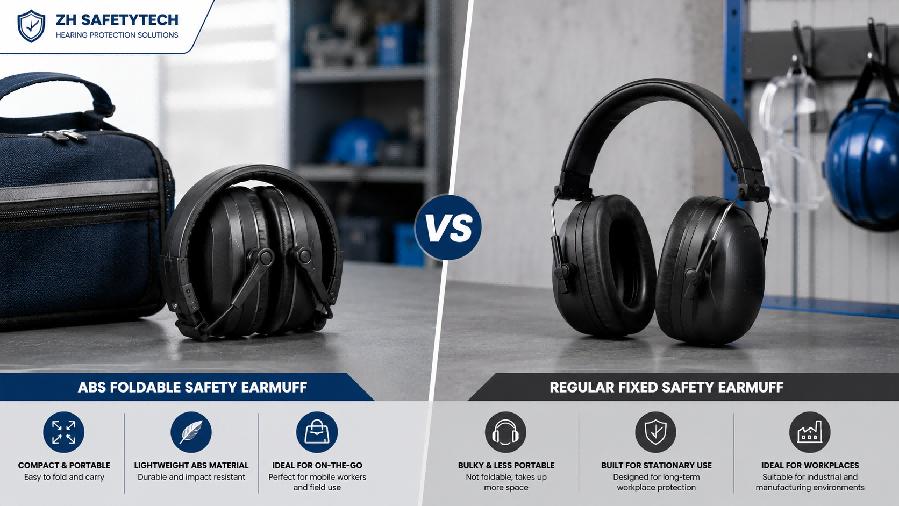
An ABS foldable safety earmuff is usually the better option when portability, compact storage, retail packaging, and field mobility matter. A regular fixed earmuff can still be suitable for stationary workplaces where the earmuff is stored at a workstation and rarely transported. For PPE distributors and private-label buyers, the right choice depends on application scenario, expected noise reduction, comfort requirements, packaging strategy, and certification documents. ZH SafetyTech can support buyers comparing both options through hearing protection product customization and OEM project discussion.
| Factor | ABS Foldable Safety Earmuff | Regular Fixed Earmuff |
|---|---|---|
| Portability | Usually stronger because the earmuff can fold into a smaller shape. | Usually bulkier to carry. |
| Storage | Better for tool bags, PPE kits, retail shelves, and compact cartons. | Better for wall hooks, workstations, and fixed PPE stations. |
| Structure | Requires a reliable hinge or folding mechanism. | Simpler structure with fewer moving parts. |
| Branding | ABS shells often support molded color and logo customization. | Also customizable depending on shell design. |
| User scenario | Mobile workers, contractors, retail customers, range bags, and portable safety kits. | Factories, maintenance rooms, and controlled PPE distribution points. |
| Key risk to check | Hinge durability and folding stability. | Bulkiness and storage convenience. |
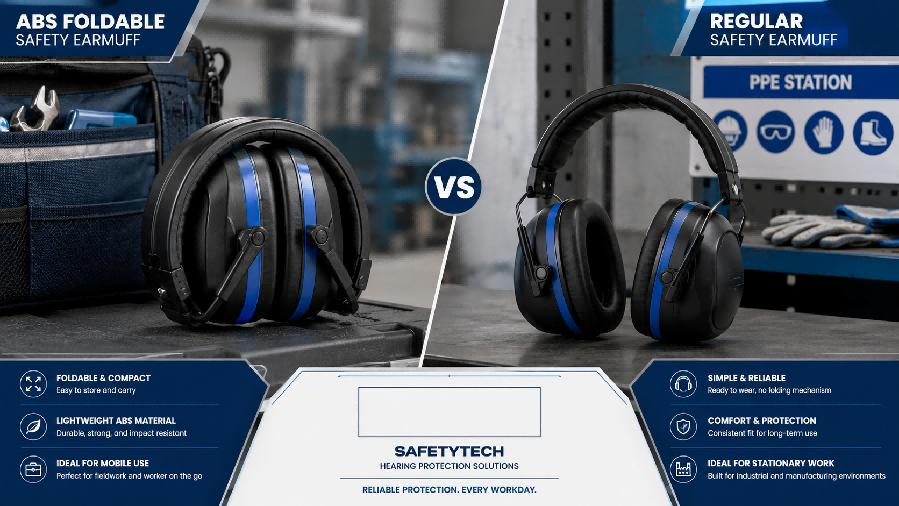
Your customers need to carry earmuffs between multiple work areas.
Your product will be sold through retail, e-commerce, or PPE kits where package size matters.
You want a product positioned around convenience, storage, and repeated transport.
You need customizable colors, logo placement, and shell styling for brand differentiation.
You are developing a mid-range or premium safety earmuff line where user experience matters.
A regular fixed earmuff may be enough when the product stays in one place, such as a designated factory PPE station. It may also be preferred when the buyer wants the simplest structure possible. However, if the end user needs to pack the product into a tool case, store it in a vehicle, or carry it to outdoor jobs, a foldable model can improve the real-world experience.
ABS is commonly used in molded consumer and industrial products because it can provide a balanced combination of rigidity, impact resistance, dimensional stability, and surface finish. In a safety earmuff, ABS does not work alone; the final performance depends on the complete acoustic system. Buyers should evaluate the ABS cup, inner foam, cushion seal, headband pressure, and test results together.
The keyword “abs foldable safety earmuff” should not be interpreted as a guaranteed noise reduction value. NRR, SNR, or other attenuation data must be checked on the specific model and test report. CDC/NIOSH notes that hazardous noise can begin at 85 dBA or higher, so workplace buyers should match hearing protection to actual measured exposure and local requirements.
ZH SafetyTech’s website describes passive hearing protectors, safety hearing protection, and customized hearing protection solutions. The company states that it can support customization around model function, Bluetooth, NRR, button/light, charging mode, headband style, color, folding patterns, external microphones, chip upgrades, packing, quality control, certificates, and shipping. For buyers comparing foldable and regular earmuffs, this makes ZH SafetyTech a relevant partner for discussing specification trade-offs rather than choosing a generic catalog item only.
Define the noise environment and required attenuation first.
Decide whether users carry the earmuff daily or store it at a fixed station.
Compare folded dimensions, unfolded fit, and package size.
Check hinge durability, headband force, and cushion comfort through samples.
Review certificates, labeling requirements, and target-market compliance.
Confirm OEM options such as color, logo, instructions, packaging, and carton plan.
A: Not necessarily. A well-designed hinge can be durable, but buyers should request samples and cycle testing information before mass orders.
A: It can be suitable if the product’s certified attenuation and design match the job-site noise conditions and local safety requirements.
A: Ask for model options, NRR/SNR data, available certificates, folded dimensions, logo methods, packaging options, MOQ, sample lead time, and mass production lead time.
ZH SafetyTech official website: https://www.zhsafetech.com/
ZH SafetyTech customization page: https://www.zhsafetech.com/customize/
ZH SafetyTech passive hearing protector page: https://www.zhsafetech.com/passive-hearing-protector/
CDC/NIOSH occupational noise guidance: hazardous noise can reach 85 dBA or higher.
E-mail:
Tel:
+86 158 8886 1058
Add.:
No. 6, Shunle Road, Jingshan Town, Yuhang District, Hangzhou City, Zhejiang Province, China
Copyright © Hangzhou ZH Tech Co., Ltd. All Rights Reserved |
Sitemap
| Technical Support: